

As a follow up to my post on The Zero(ish) marginal costs of software, lets look at one of the features of software markets that I think is awesome: open source.
There are lots of reasons open source exists, but I’m going to look at this solely from an economic perspective.
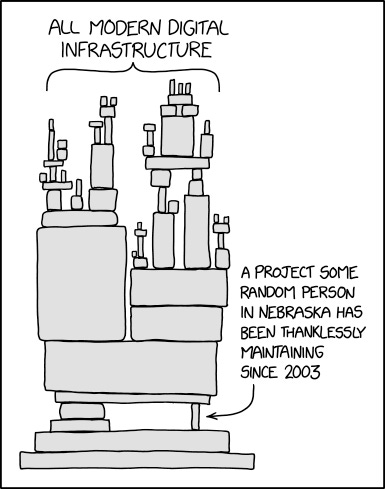
Open source software exists because the marginal cost per user of software at sufficient scale is (nearly) 0, and as a result in a competitive market firms will produce where marginal cost = marginal revenue -> marginal revenue is $0 and the software is free.
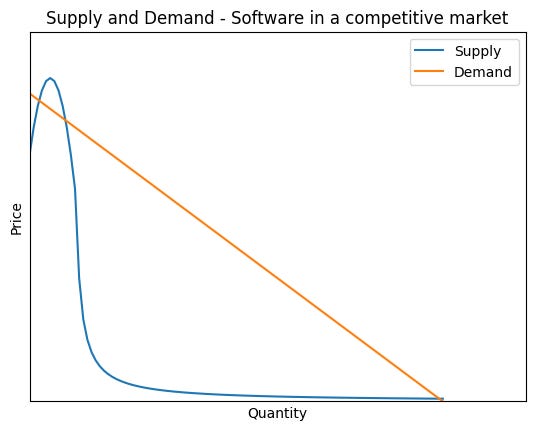
So any competitive market for software will essentially tend to the point where the price of the software is practically $0, and producers will need to make money doing something else (like consulting) in order to stay alive.
This explains why so many libraries, programming languages and databases are open source and free - the switching costs are relatively low, and there is lots of competition with limited barriers to entry. "Firms" (in this case open source developers) are attracted by altruistic value and/or kudos and/or the belief that their software is somehow better and they want to change the world for the better.
If the makers of python suddenly decided to charge $10/user, the user base would drop massively and lots of people would switch to another language.
Software can be charged at non-zero revenue where the product has monopolistic tendencies - for example, where there are agglomeration benefits in everyone using the same product to allow them to collaborate (eg. Microsoft Office), or if the software contains some sort of non-trivial technical or usability innovation that is difficult to replicate (product-led moat).
The middle ground between these two is services - where you have a fundamentally free software product, but the effort required to get it working for is significantly non-zero. This creates an opportunity for a business to package that software into a "service" which is then sold at a huge markup.
If your software product has existing free competitors and you have no way to service-ise the business, you’re going to have a very hard time building a business around it.
The flip side of this is that in software, we see more knowledge sharing and technological catch-up than in other sectors, which in turn fuels even more innovation.
We’re seeing this in the AI space at the moment with tools like HuggingFace drastically reducing transaction costs and improving access to AI models. The most interesting space in AI at the moment is Open Source models - free and easy access to this technology fosters innovation and invention.
My prediction is that the real breakthroughs in AI will come from the open source community (and those participating in it), rather than from closed-source businesses like OpenAI.
Either way, it’s going to be a fascinating space to watch and be a part of.