
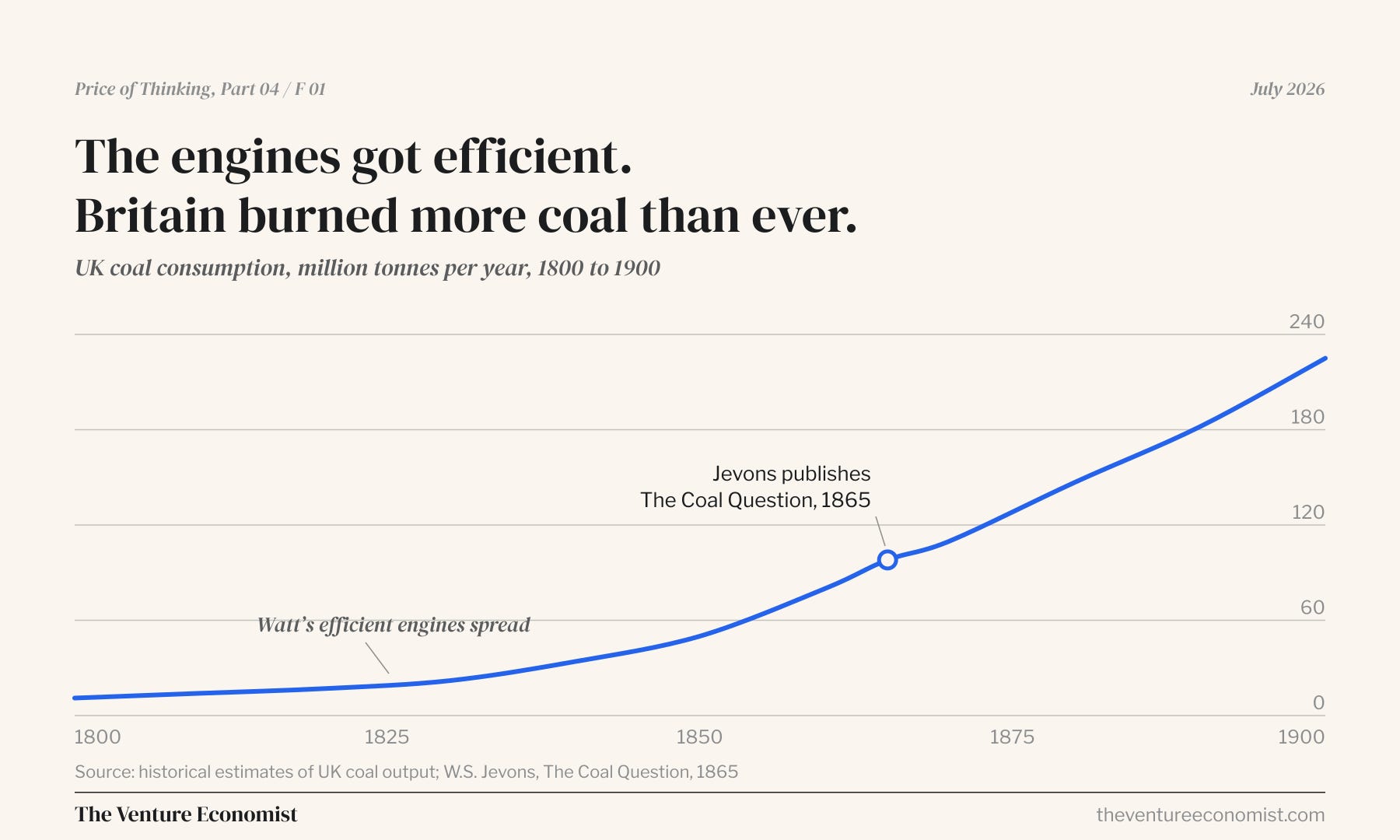
In 1865, a young English economist named William Stanley Jevons published a book warning that Britain would run out of coal. His most interesting argument was about efficiency. James Watt’s steam engine used a fraction of the coal per unit of work of the engine it replaced, and the sensible expectation was that Britain’s coal consumption would fall. It soared. Jevons put it plainly: “It is wholly a confusion of ideas to suppose that the economical use of fuel is equivalent to a diminished consumption. The very contrary is the truth.”
Watt made coal so productive that steam power became worth deploying everywhere, in mills and mines and ships and railways that could never have justified the fuel bill before. Efficiency lowered the cost of an outcome, demand for outcomes exploded, and total coal consumption rose with it.
One hundred and sixty years later, the same paradox is running again. This time the fuel is thinking and the outcomes are almost everything we associate with intellectual work.
What is the Jevons Paradox?
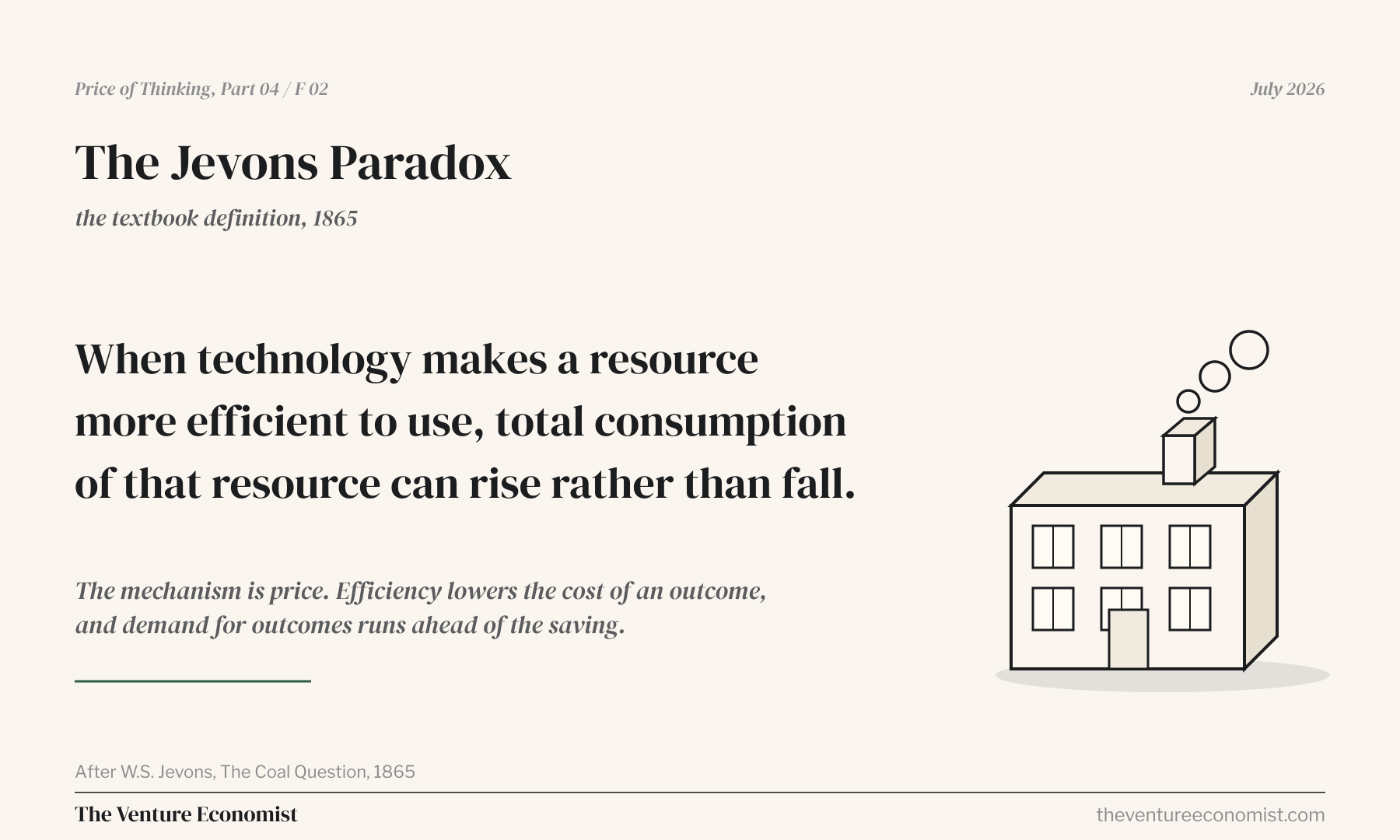
The Jevons Paradox is the observation that when technology makes a resource more efficient to use, total consumption of that resource rises. The mechanism is price. Efficiency lowers the effective cost of achieving an outcome, and when demand for that outcome is elastic, the quantity demanded grows faster than the efficiency gain saves.
The paradox requires an economic environment where there is a large reservoir of demand that is not met at the old, higher price. Britain in 1865 had an almost unlimited appetite for mechanical work it could not yet afford. That is the condition to test AI against.
How fast are AI token prices falling?
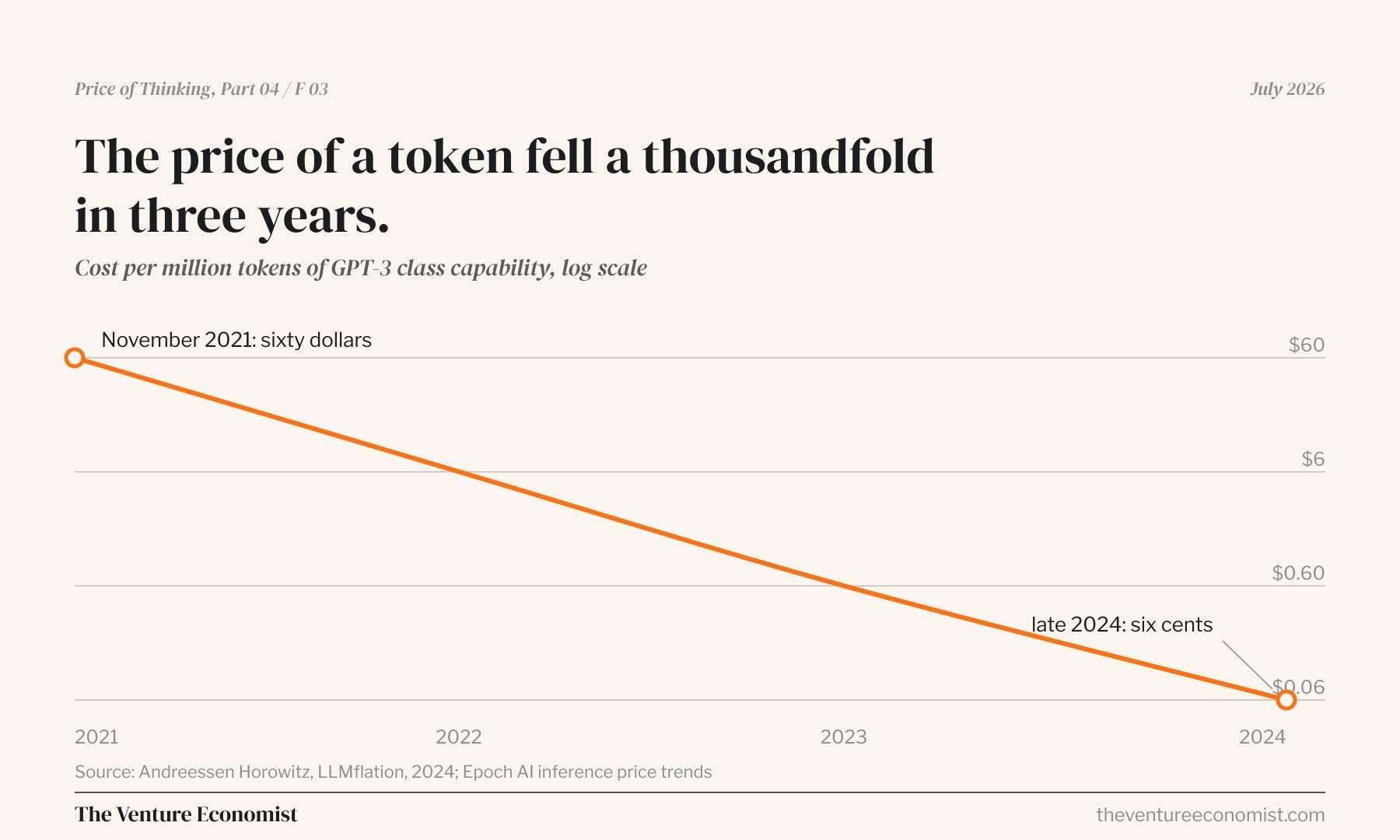
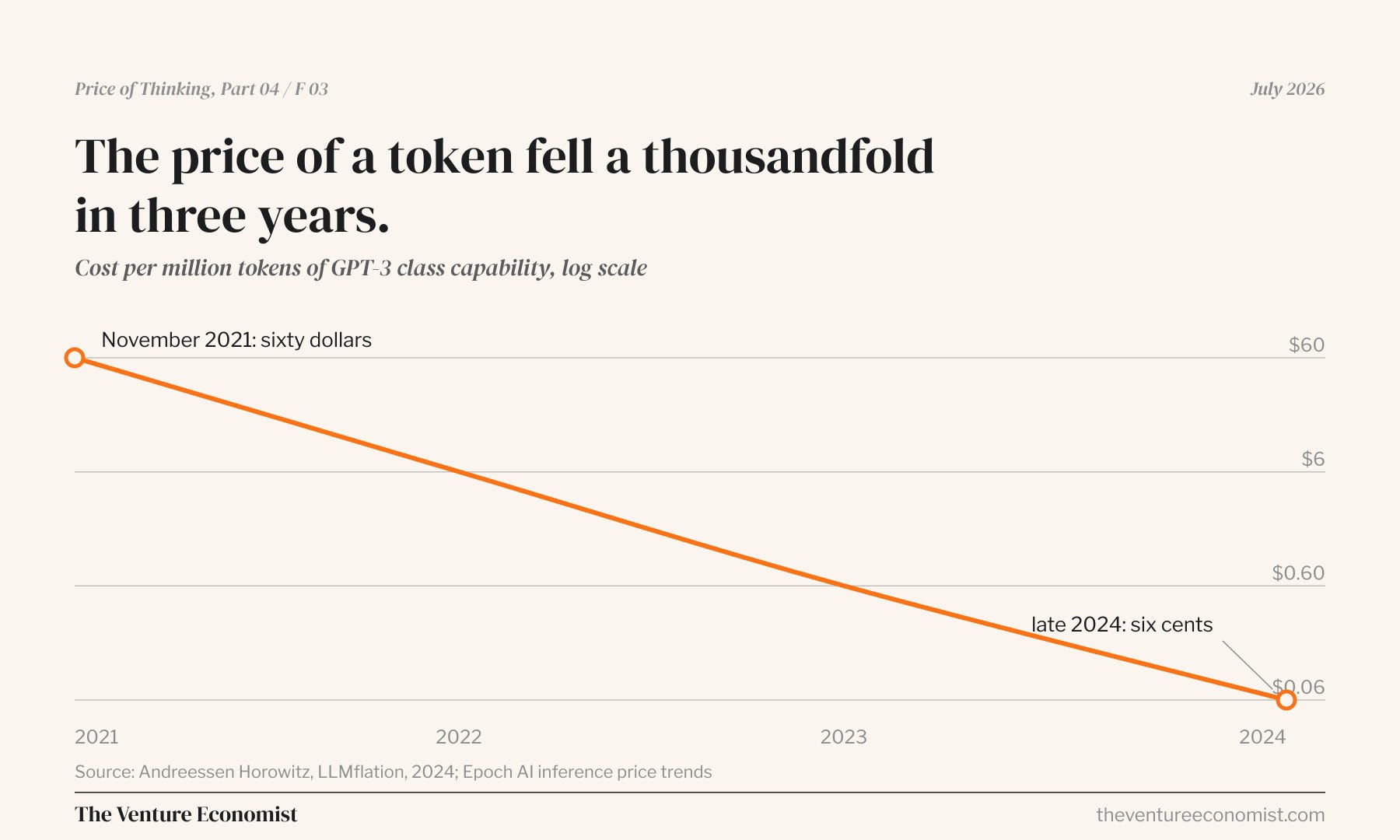
In November 2021, running a model of GPT-3 quality cost 60 dollars per million tokens. By late 2024, the same capability cost six cents, a thousandfold decline in three years, a trend Andreessen Horowitz measured at roughly 10x per year and named LLMflation. Epoch AI, measuring across a wider set of tasks, found the median price of a fixed level of capability falling around 50x per year. There is no precedent for this. Compute during the PC era and bandwidth during the dotcom boom both got cheaper at a slower rate.
If intelligence were an ordinary expense, spending on it should be evaporating.
Why is AI consumption rising while prices fall?
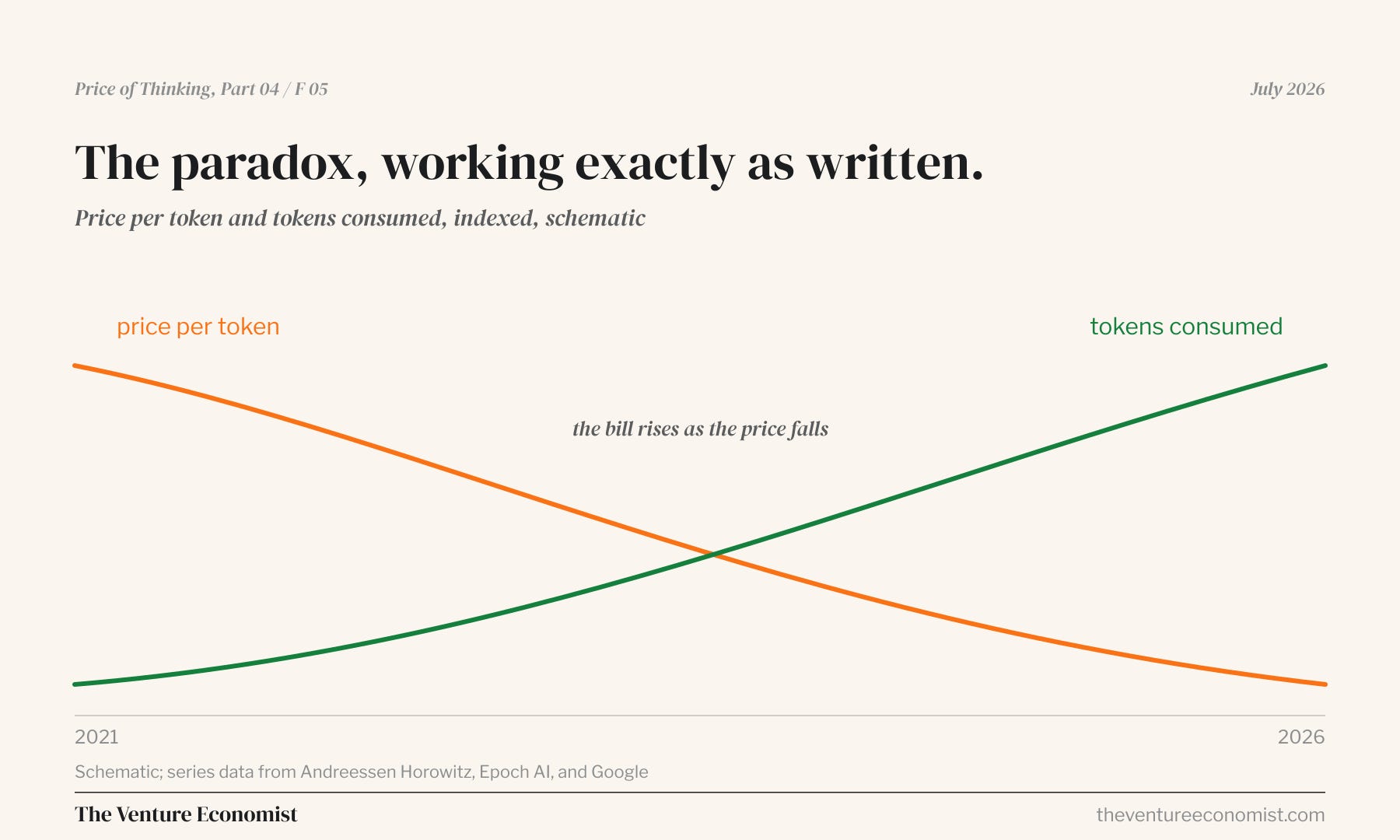
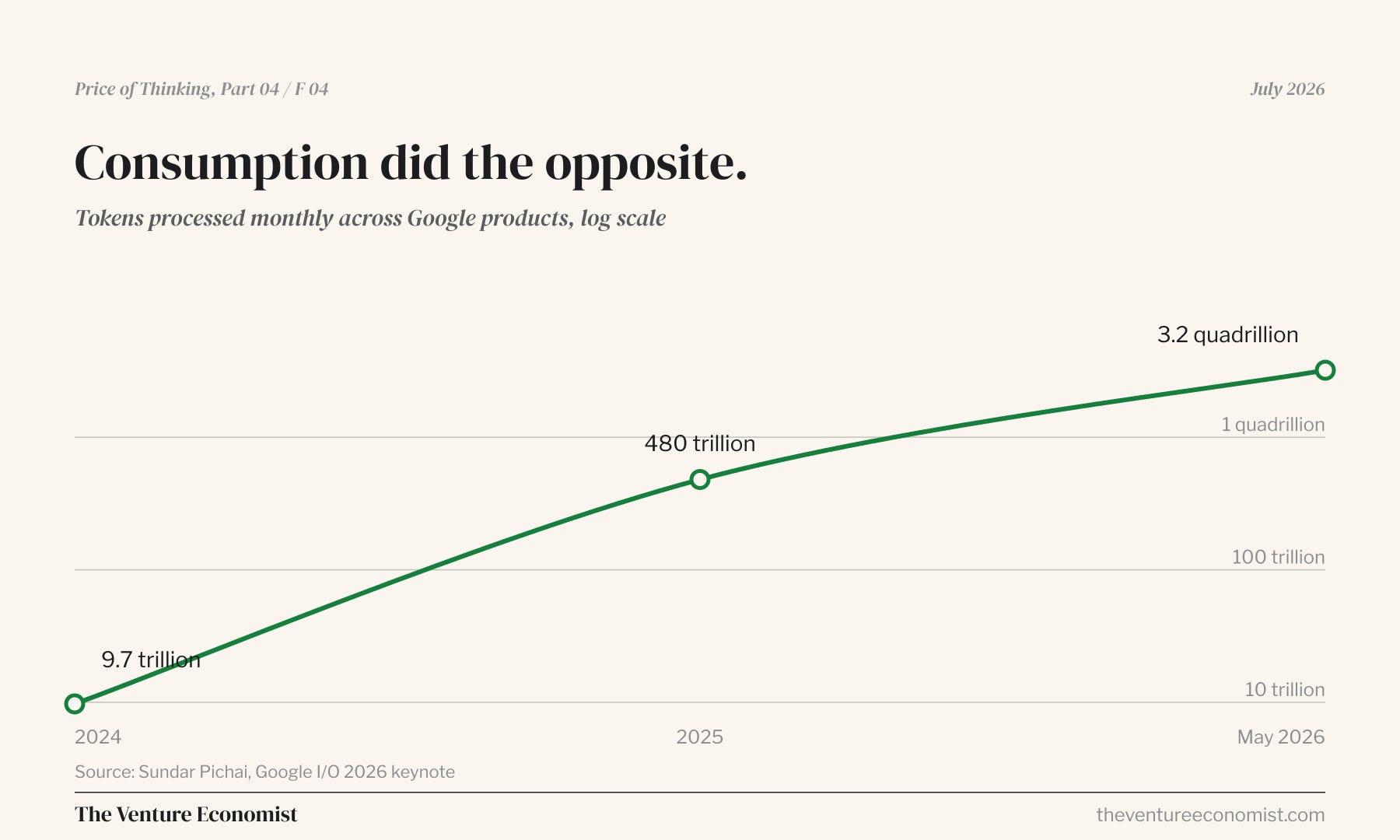
Google publishes its own usage stats. In 2024 it processed 9.7 trillion tokens a month across its products. A year later the figure was 480 trillion. By May 2026 it passed 3.2 quadrillion tokens a month, a sevenfold rise in a single year. Enterprise spending tells the same story from the buyer’s side: Menlo Ventures tracked generative AI spend in the enterprise going from 1.7 billion dollars in 2023 to 11.5 billion in 2024 to roughly 37 billion in 2025. The unit price fell by orders of magnitude and the total bill rose by orders of magnitude.
It turns out the latent demand for intellectual work is huge. At 60 dollars per million tokens, you spend tokens carefully, on the few tasks that clearly justify them. At six cents, you spend them on everything. You let a model draft ten versions instead of one. You let it read the entire document set instead of a summary. You let agents burn thousands of tokens checking their own work, because checking is now cheaper than the error it prevents. Whole categories of thinking that were absurd at the old price are routine at the new one, and each new category adds to consumption faster than the price decline subtracts from it.
Does The Jevons Paradox apply to AI and knowledge work?
Jevons was writing about the fuel of physical work, and his paradox explained why an age of efficient engines became the age of maximum coal. Tokens are the fuel of intellectual work, and the same logic now explains why an age of collapsing AI prices has become the age of maximum thinking.
In my next article, I want to tie some of this together. My logic is this: humans performing high-level intellectual and relationship work are complementary to AI. Not only that, but AI promises increased productivity for the humans able to work alongside it.
Both of these point in the direction of rising latent demand AND falling unit costs of human intellectual labour.
I think that where this leads is the biggest boom in intellectual labour demand in history.