
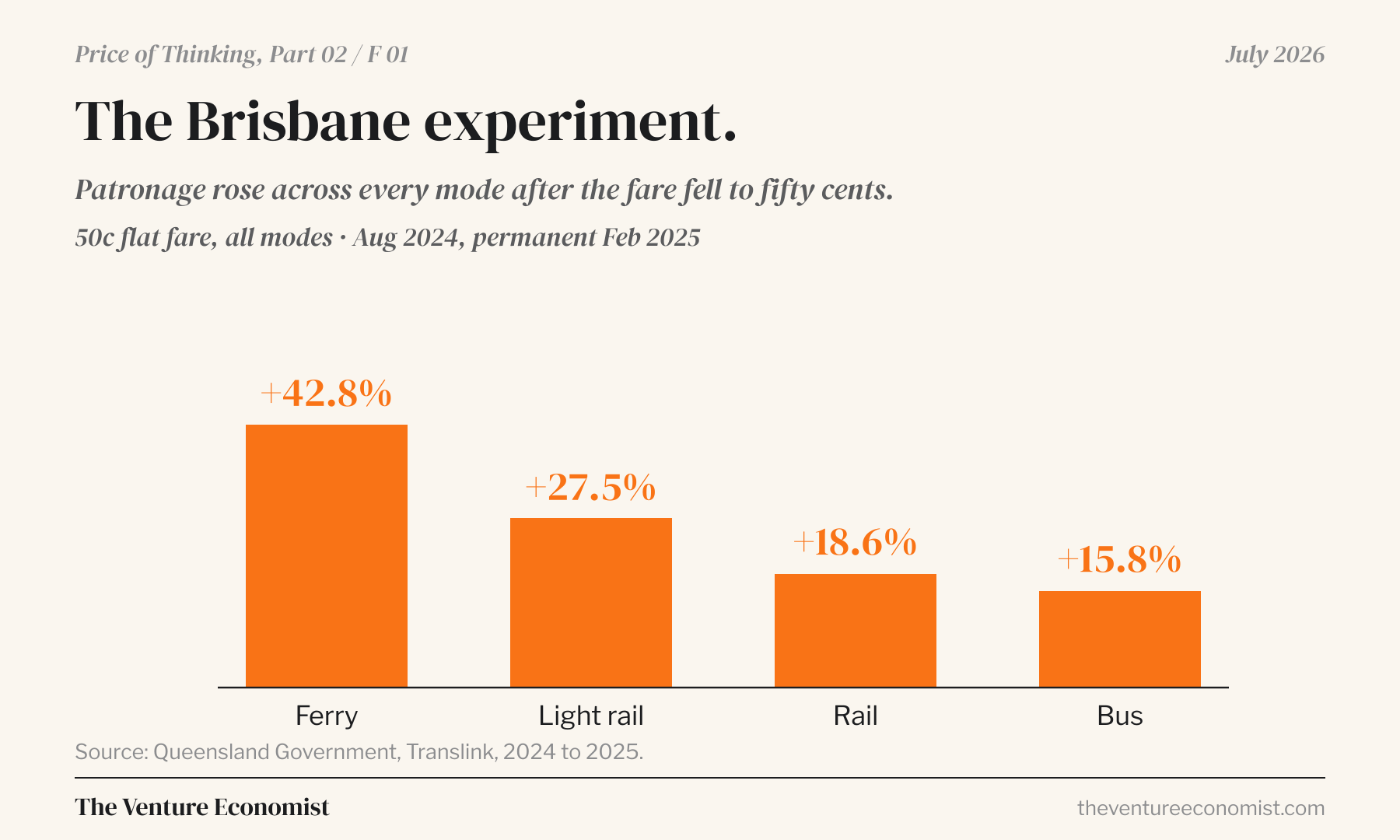
My home town just ran a live experiment in substitute goods. In 2024, Queensland cut every public transport fare to a flat 50 cents, and locked it in permanently in early 2025. The bus did not change. You still walk to the stop, stand in the rain, and lug your bags up the steps. The car did not change either. The only thing that moved was the relative price, and trips across the south east network rose 16 per cent in the six months that followed.
That is a substitute good doing the one thing a substitute does. It is also the cleanest way to understand what just happened to your job.
What is a substitute good?
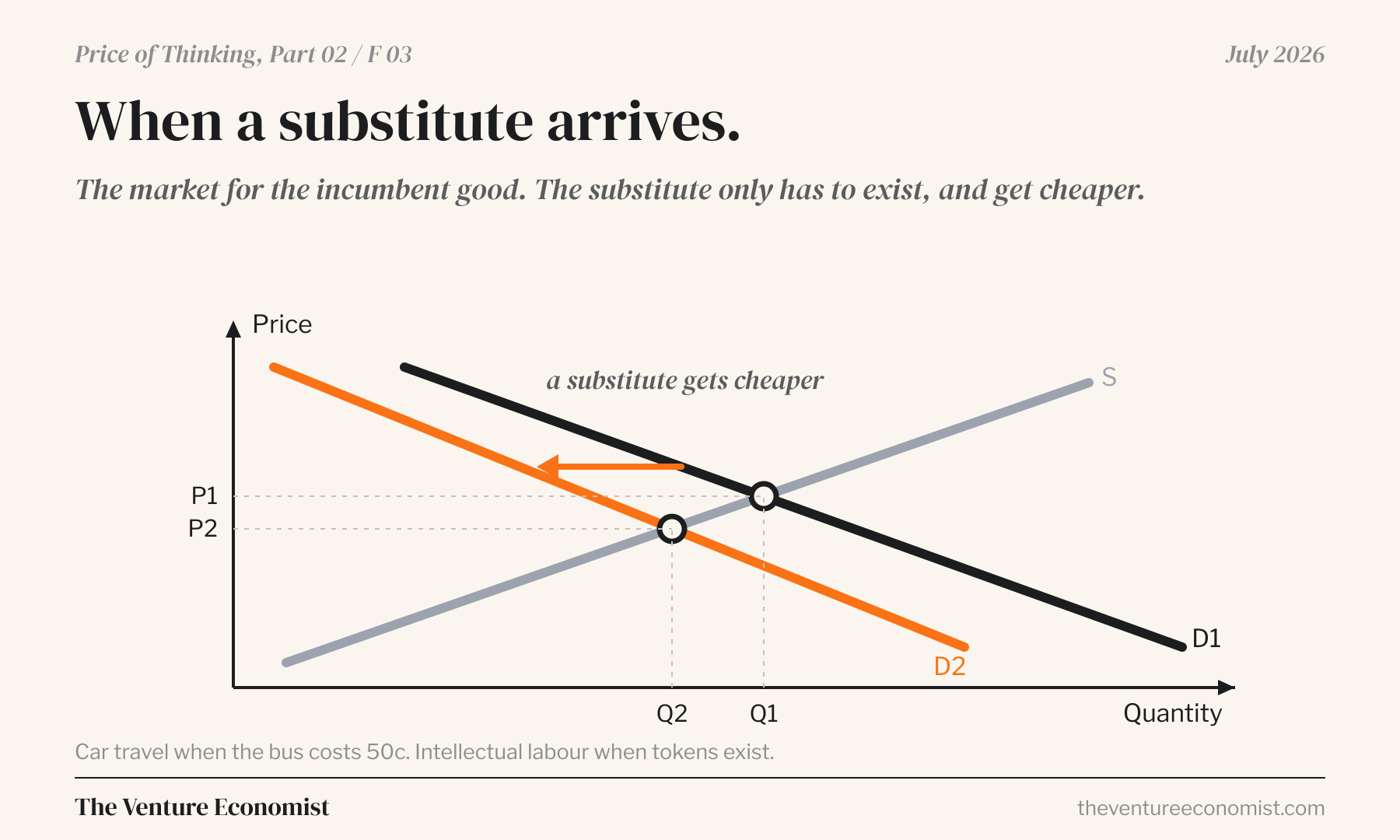
A substitute good is a good that can be used in place of another. Tea and coffee. Butter and margarine. The bus and the car. Formally, substitutes display positive cross elasticity of demand, which means that when the price of one rises, demand for the other rises with it, because buyers move between them.
The part that matters is the part the bus just demonstrated. Nothing in that shift came from opinion. Nobody’s view of the bus changed, and whether you personally think a bus compares to your own car is irrelevant to the economics. The substitution became attractive enough at the margin, enough people re-decided, and the whole market moved. A substitute does not have to be as good as the thing it replaces. The bus is worse than the car. It still empties the road.
The first substitute for intellectual labour
By intellectual labour I mean the work that can be delivered through a keyboard and a mouse. That is reductive, and it is also most of what white collar work has become.
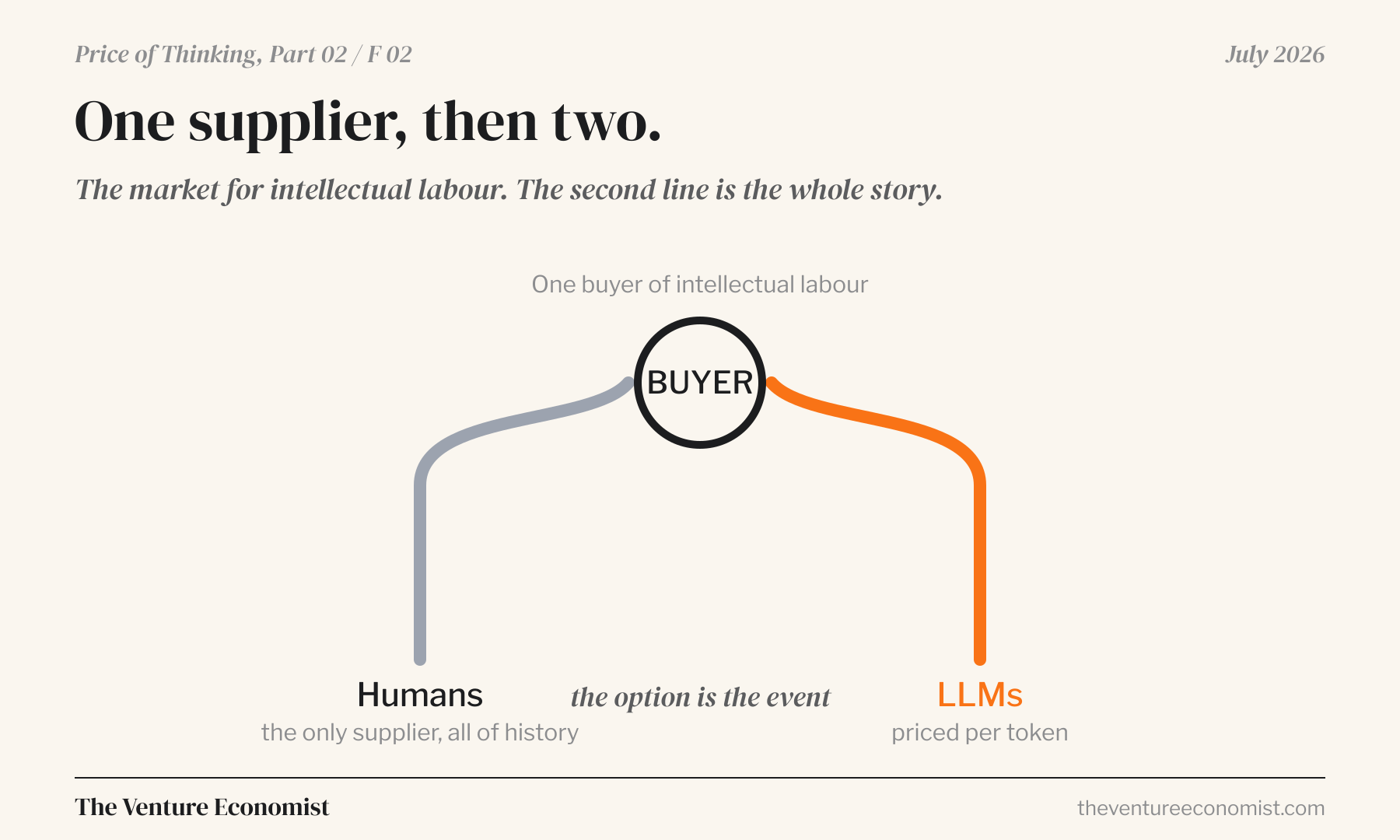
For all of economic history, that labour had exactly one supplier: a person. If you wanted thinking done, you convinced a human to do it, or the thinking did not happen. Intelligence was never a tradeable good in its own right. It came bundled inside people, with contracts, notice periods, relationships, and management overhead.
LLMs end that arrangement. For the first time, a firm can buy intellectual labour from something other than a person, priced per token. That makes the LLM the first true substitute good for intellectual labour, and the claim does not rest on my opinion of the technology. It rests on how firms now talk. AI is openly named as the reason behind restructures and hiring freezes, and when a buyer explains a decision by pointing at the alternative, the alternative is a substitute.
Does AI have to be better than humans to take work?
This is where the doom sets in, and the doom is half right. The substitute exists, and that fact alone changes the competitive dynamic for labour. What the doom gets wrong is the obsession with quality. Every week someone posts a screenshot of a model doing something ridiculous, as if that settles the matter. The bus is worse than the car. It still empties the road. A poor substitute still moves demand for the thing it stands in for, and each new model quietly improves both the quality and the relative price of this one.
Why this substitute is different from every tool before it
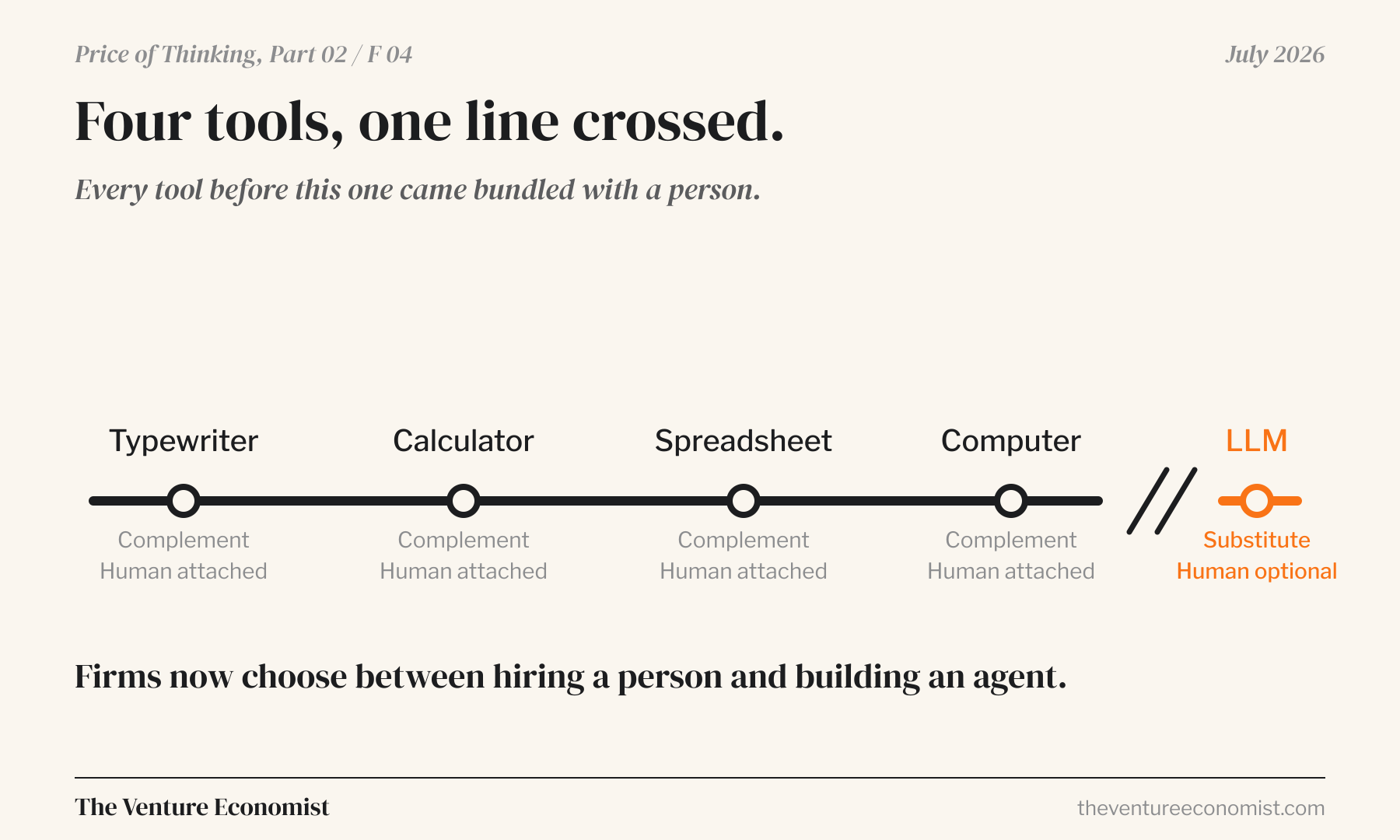
Every previous tool of intellectual work was a complement, not a substitute. The typewriter, the calculator, the spreadsheet, the computer itself. They transformed jobs and compressed whole professions, and through all of it the substitute for a bookkeeper was always a human using a better tool. There was no version of the work with no human in it at all.
That is the line we have just crossed. For the first time, firms are choosing between hiring a person and building an agent.
But a substitute is only half of what AI is. The same technology that can stand in for a person can also make one far more valuable, and that is where this series goes next.