

Part one, in two minutes:
TLDR: Walmart now lets an AI negotiate with some of its suppliers, and nearly three in four of those suppliers say they prefer it to a human buyer. It sounds like a small story about procurement. I think it is the start of one of the largest changes in economics.
The buyer changed
Walmart has more than 100,000 suppliers, and many of the smallest never had their contracts negotiated at all. There were too many of them for its human buyers to talk to one by one, so the terms just rolled over year after year. So Walmart tried something new. Starting in Canada, it let a chatbot built by a company called Pactum negotiate with suppliers of things Walmart uses rather than sells: shopping carts, equipment, services.
The bot opened talks with each supplier, asked what mattered to them, and traded on it: a longer contract for a lower price, faster payment for a discount. By the time Bloomberg reported on it in April 2023, Walmart had taken it to the United States, Chile and South Africa. Walmart said the bot reached deals with 68% of the suppliers it approached, closed them in days rather than weeks, and saved an average of 3%. Then came the surprising part. Nearly three in four of the suppliers said they preferred negotiating with the bot to negotiating with a person.
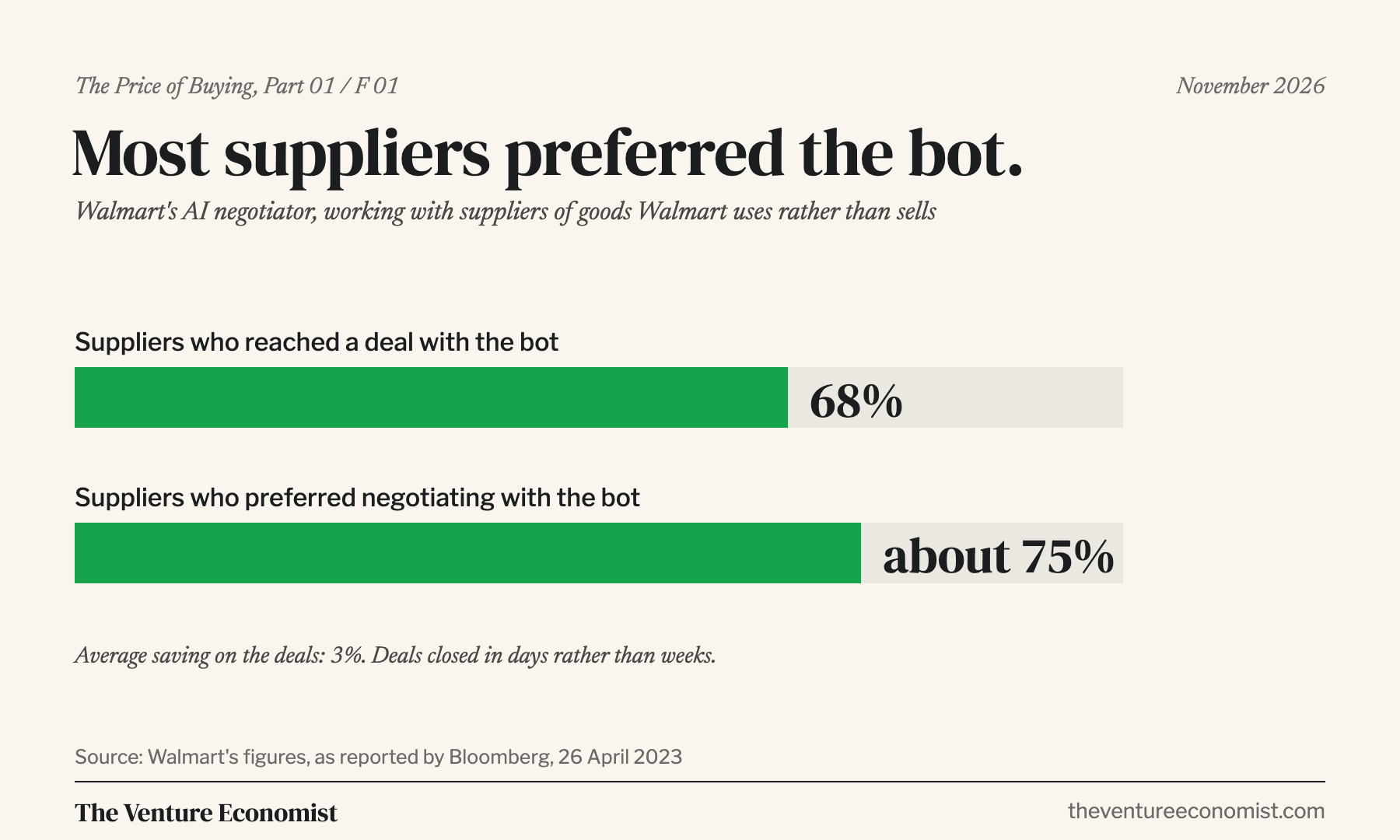
The suppliers were still people, selling the way they always had. Only the buyer had changed.
It isn't only Walmart, and it isn't only overseas. In January this year, in a trial run by Mastercard with the Commonwealth Bank and Westpac, an AI agent bought cinema tickets in Australia. The cinema was paid the way it is always paid. Nothing in the sale looked different, except who made it.
Economics assumes the buyer is a person
Economists describe a market as buyers and sellers, and almost every model we have assumes both are people. That assumption does a lot of quiet work. A great deal of economics turns out to be a description of the human buyer.
We get tired of searching, so the same thing can sell at different prices for years. We stay with a supplier out of habit, so loyal customers often pay more than new ones. We are moved by a familiar name, a jingle, a countdown clock on a checkout page. We can't see every price, so some businesses earn their margins from what we can't see.
An AI buyer has none of those limits. It doesn't get tired at four in the afternoon or skip the fourth quote because it's Friday. It has no habits, it doesn't watch the ads, and it can ask everyone.
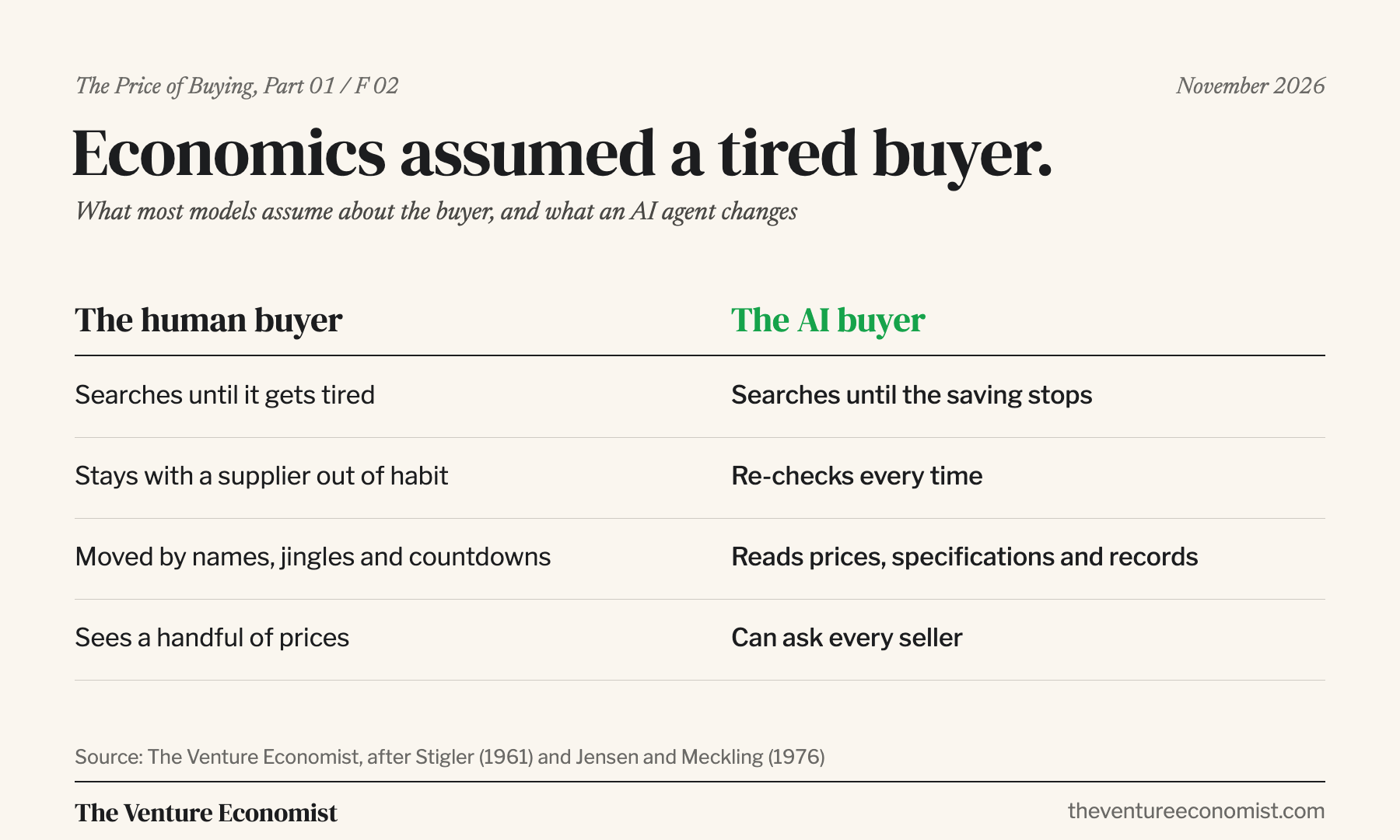
Economics does have a theory of agents. In 1976, Michael Jensen and William Meckling described the problem of a principal who hires an agent to act for them, and the agent who has interests of their own: the manager who spends shareholders' money on a bigger office. The new agent breaks that model in both directions. It wants nothing for itself. But it is literal. It does what it was asked, which is not always what was meant. The human part of buying, deciding what is wanted and answering for the result, becomes the part that matters most.
The buying side will change first, because buying is a set of steps the buyer controls: work out what you need, find who can supply it, compare, ask for prices, choose and pay. Selling depends on persuasion, and the seller doesn't decide when it's finished. There is a twist, though. OpenAI launched a way to buy things inside ChatGPT in September 2025 and shut it down about five months later after weak take-up. My reading is that shopping for yourself is one of the parts of buying people enjoy. The buying nobody enjoys, reordering stock, chasing quotes, renewing contracts, is where agents will arrive first. In business, most buying is that kind.
We've made this mistake before
For three years, almost everything written about AI and the economy has been about supply: who makes intelligence, what it costs, which jobs it replaces, who controls the chips. That matters. But it is half of the economy.
Three hundred years ago, the mercantilists made the same mistake. They counted a country's wealth in what it made and stockpiled, gold above all, and thought hard about production and the balance of trade. They thought very little about what people wanted to buy.
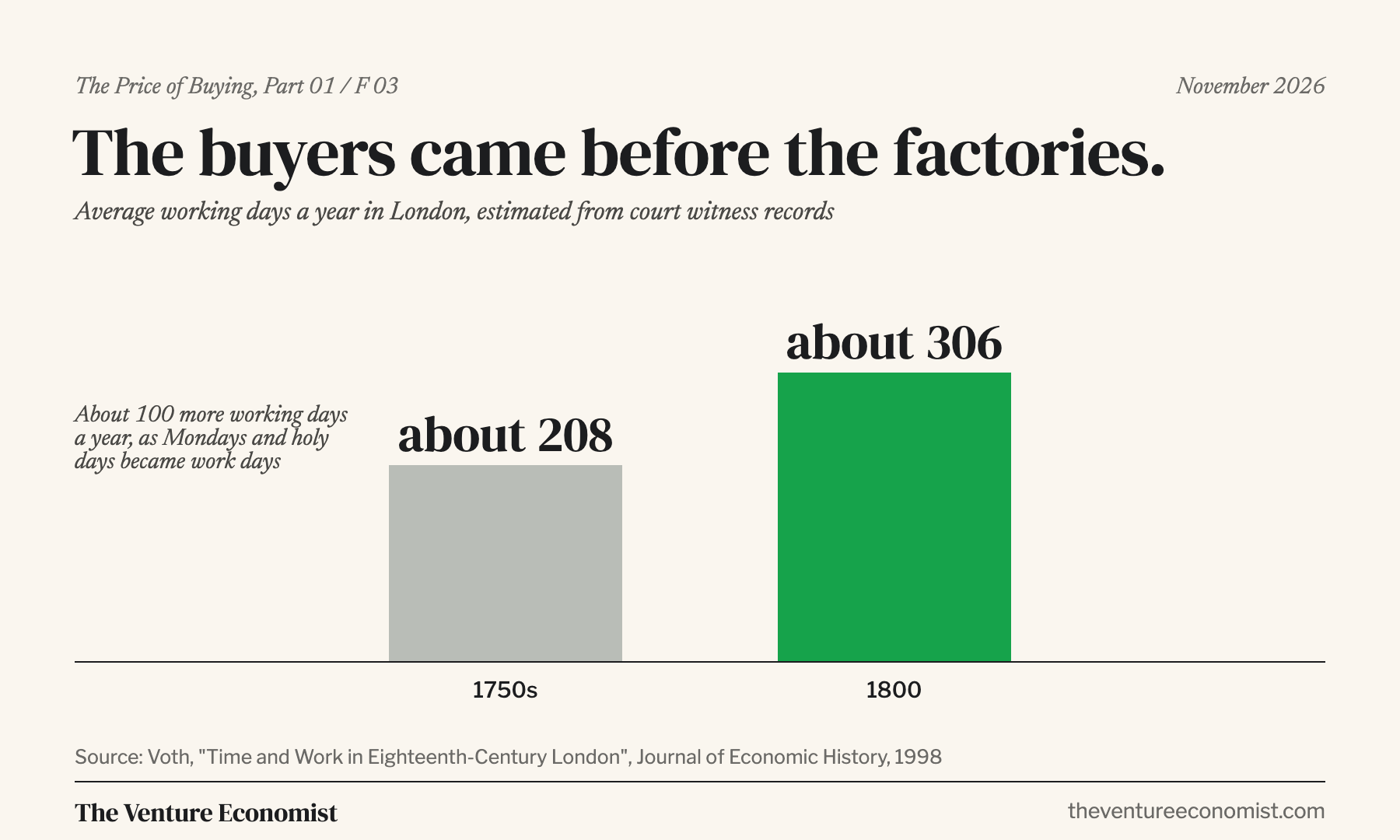
What began to transform Britain started on the buying side. Ordinary households developed a taste for tea, sugar, tobacco and printed cotton, and chose to work more to afford them. Families worked at least fifty more days a year to pay for them. The economic historian Hans-Joachim Voth, working from London court records, puts the change even higher: from about 208 working days a year in the 1750s to about 306 by 1800, as Mondays and holy days became working days. Jan de Vries called it the industrious revolution, and it came before the industrial one. That spending gave the first factories their customers, and the economy reorganised itself around the buyer.
The writer Venkatesh Rao makes the comparison in an essay called Cognitive Mercantilism. We are fixed on who supplies intelligence, as the mercantilists were fixed on gold, and we have barely started on what happens when intelligence starts to buy things.
What machines can see
If the economy reorganises itself around the buyer, and the buyer becomes a machine, then the economy will start to reorganise itself around what machines can see.
A person choosing a supplier works with a few names they remember, a recommendation from a colleague and whatever turns up in a search. A machine works with whatever it can find, read and check: prices it can compare, specifications it can match, a record it can verify. A business that is easy for a person to like but hard for a machine to read will be chosen less often. A business with clear prices and a checkable record will be chosen more, whatever its size.
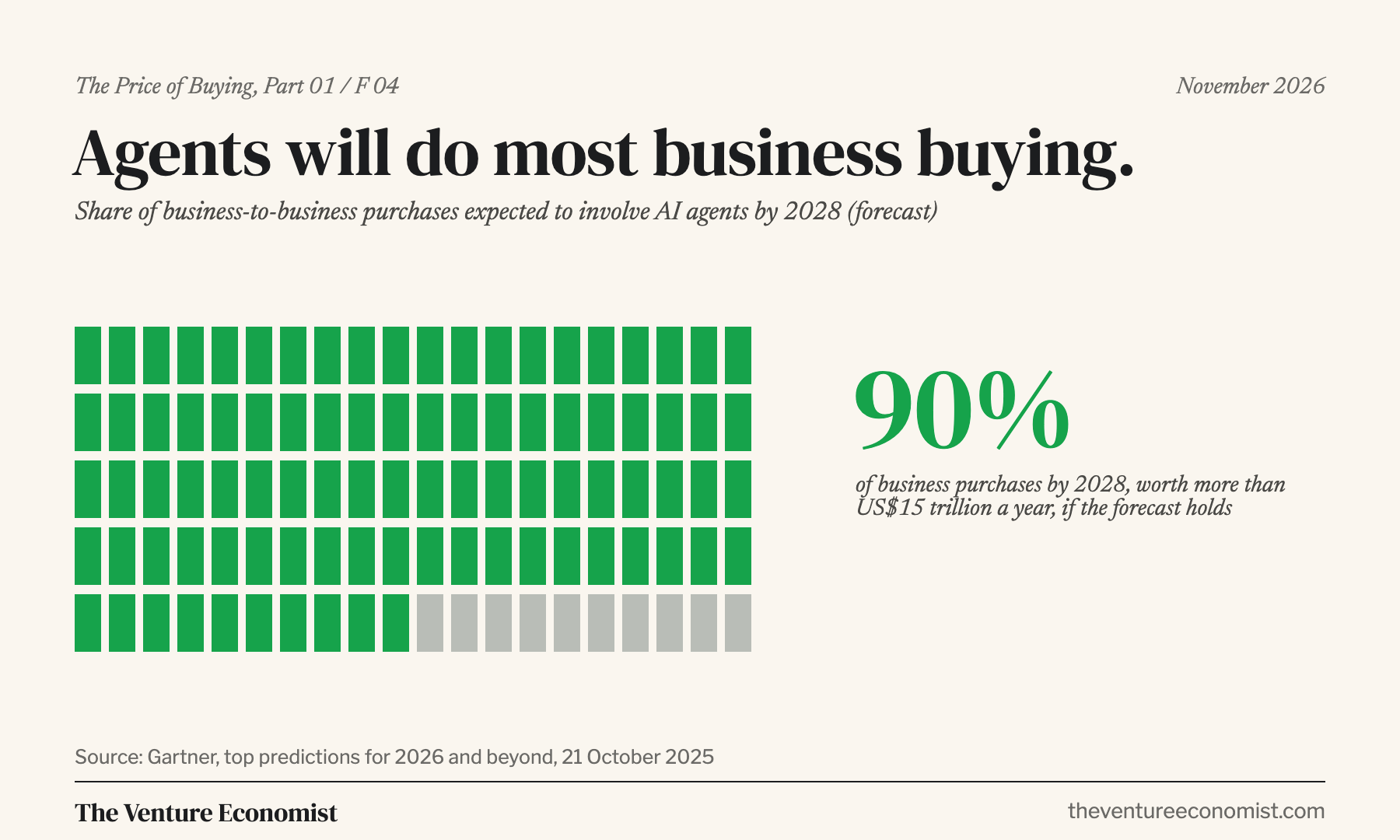
That is why I think the change will reach business buying first. Gartner forecasts that by 2028 AI agents will be involved in about 90% of business-to-business purchases, worth more than US$15 trillion a year. Forecasts like that deserve caution, but the direction is clear, and most business buying is exactly the tedious, rule-following kind that agents handle best.
None of this takes people out of the economy. The agent that bought those cinema tickets was buying them for someone who wanted to see a film. What changes is who does the work of buying, and that turns out to touch almost everything economists assumed about us.
That is what this series is about. The next part starts with the most human limit of all: what happens to the economics built on the fact that buyers get tired?
The Price of Buying is a video series first. Part two, on why loyal customers pay more, is already on the channel.
Get each new part by email:
Would you let an AI negotiate your next contract? Tell me in the comments.
Sources
Bloomberg, "Walmart Is Using AI to Negotiate the Best Price With Some Vendors", 26 April 2023
Van Hoek, DeWitt, Lacity and Johnson, "How Walmart Automated Supplier Negotiations", Harvard Business Review, 8 November 2022
Mastercard, Australia's first authenticated agentic transactions using Agent Pay, 28 January 2026
Jensen and Meckling, "Theory of the Firm: Managerial Behavior, Agency Costs and Ownership Structure", Journal of Financial Economics, 1976
Voth, "Time and Work in Eighteenth-Century London", Journal of Economic History, 1998
de Vries, The Industrious Revolution, Cambridge University Press, 2008
Rao, "Cognitive Mercantilism", Contraptions
Digital Commerce 360, OpenAI shifts checkout plans, 6 March 2026
Gartner, top predictions for 2026 and beyond, 21 October 2025