


TLDR: Copywriters and software engineers were declared finished. Both are back in demand, and the reason is the most important idea in the economics of AI.
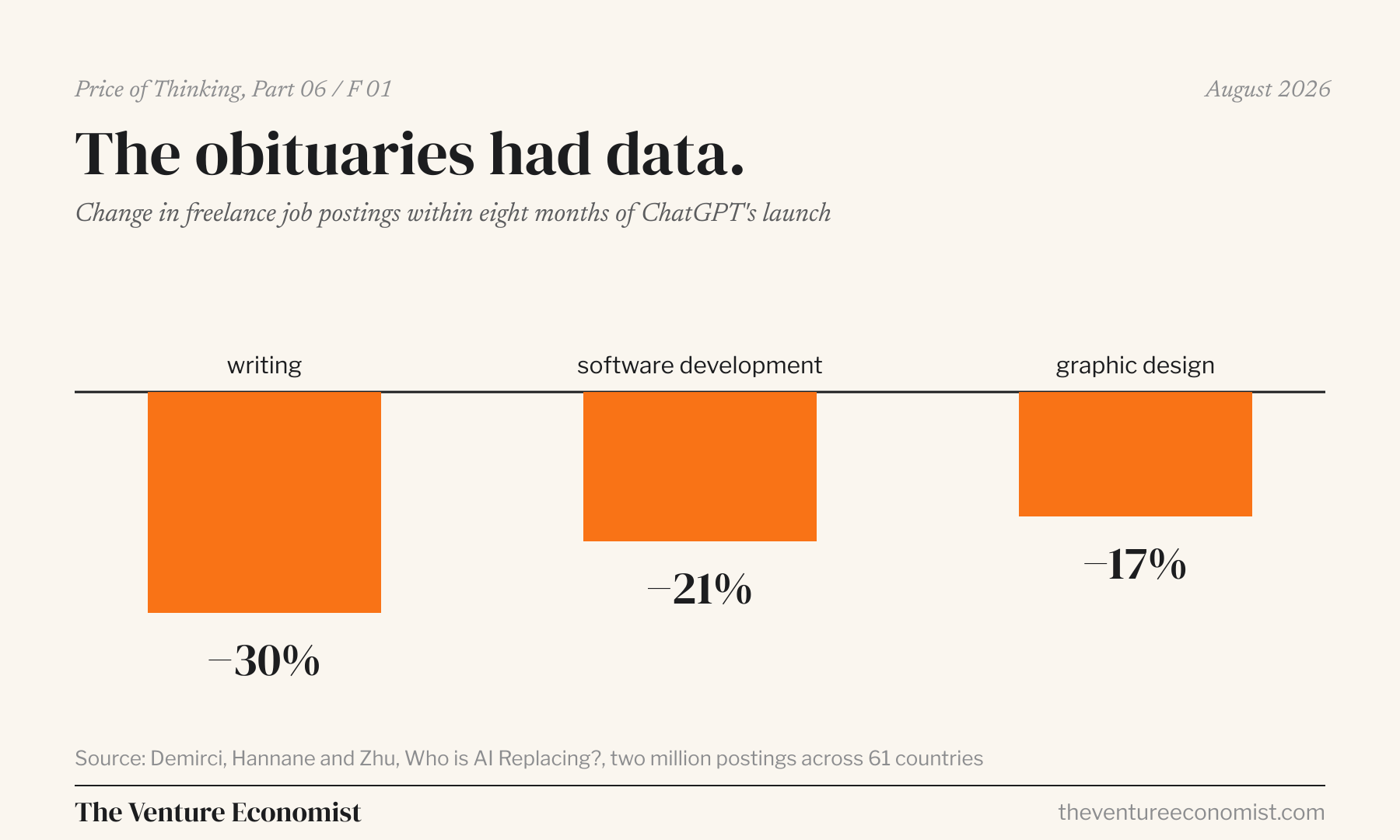
When ChatGPT launched in late 2022, content writing looked finished as a career. The data seemed to confirm it. Within months, writing jobs on Upwork fell 2 per cent and writers’ monthly earnings fell 5.2 per cent, according to research from Washington University and NYU. A larger study across two million freelance postings found demand for writing work down roughly 30 per cent within eight months, the steepest fall of any category measured. Many people read the writing on the wall and left the industry.
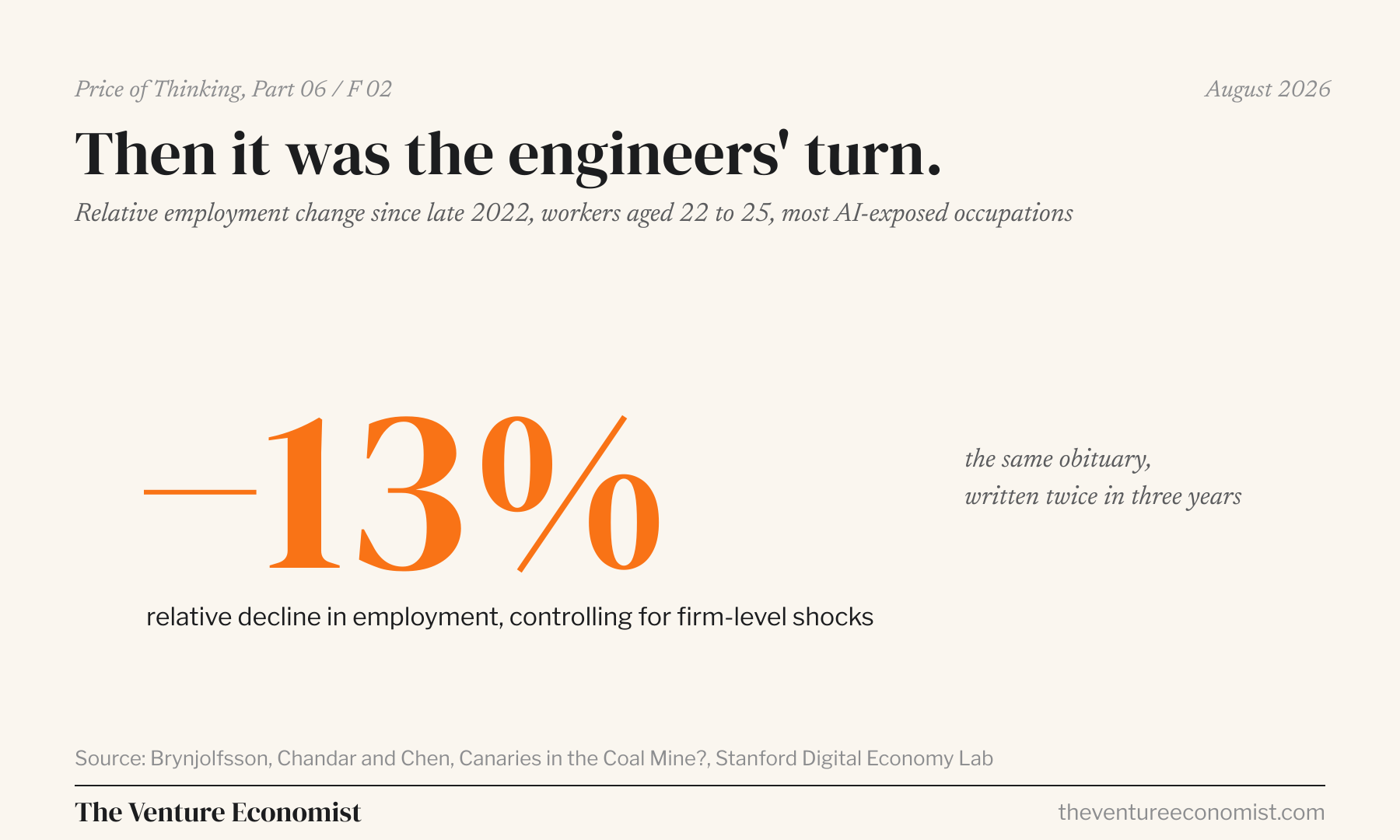
In 2025, the same feeling hit software engineers. Stanford’s Digital Economy Lab found that early-career workers in the most AI-exposed occupations, software engineering chief among them, had experienced a 13 per cent relative decline in employment since the arrival of generative AI. Headlines declared both careers a dead end.
Then something inconvenient happened to the narrative.
At the start of this year, for the first time ever, I hired a dedicated copywriter. A career that many thought was dead is back in demand, even for small startups like mine. I think the same will be true for software engineers.
Why?
Why are copywriters back in demand?
Because the role, done well, is complementary to AI, and as we covered earlier in this series, demand for complements rises when the thing they complement gets cheap.
You can already see it in the market. Searches for “how to humanize AI content” grew 943 per cent in twelve months, which is another way of saying that companies generated an ocean of text and then discovered it needed a human. A cottage industry of writers and illustrators now earns a living fixing AI-generated output, and for some freelancers those repair jobs are half their workload. The generation was cheap. The judgement was not.
What is a job, if it is more than its tasks?
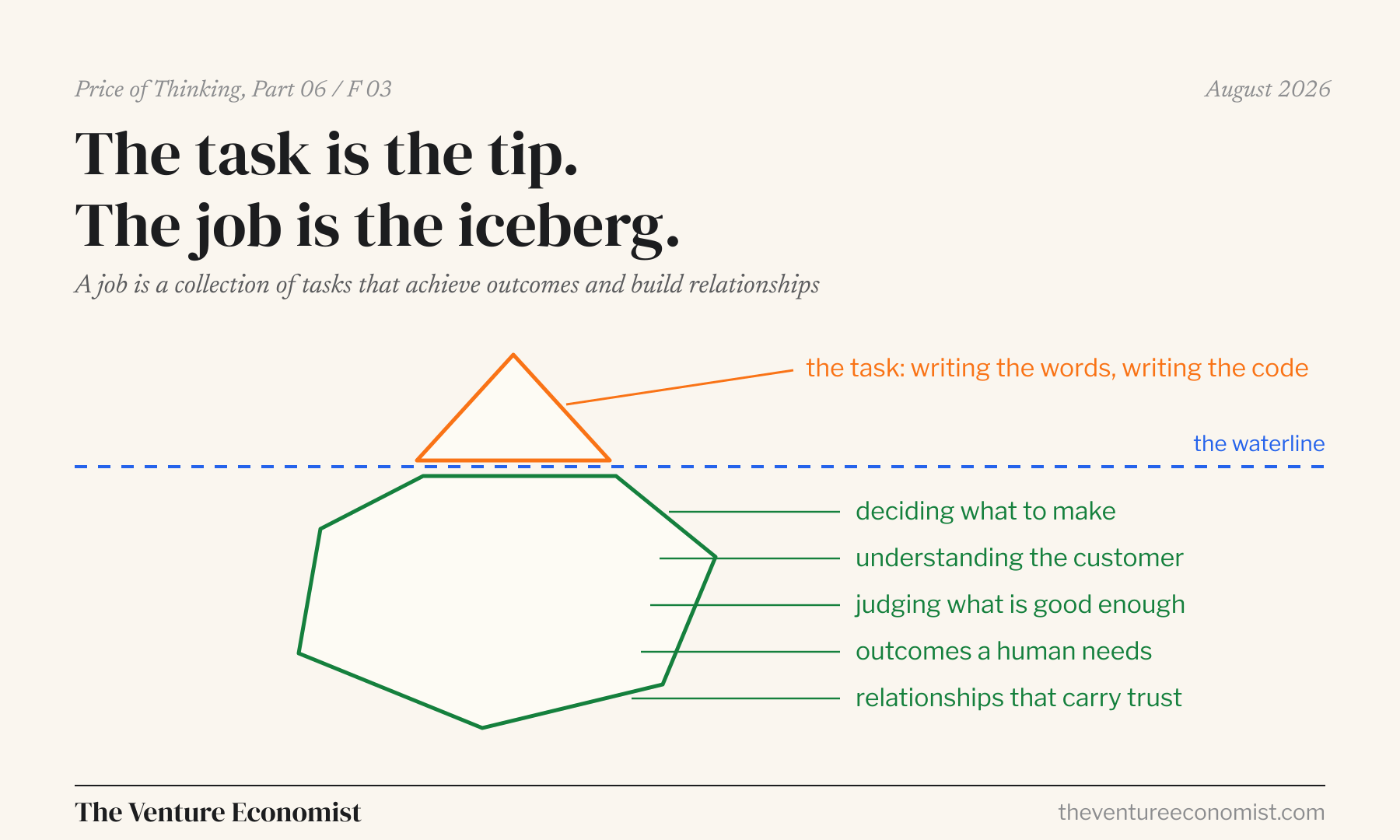
A job is a collection of tasks that achieve outcomes and build relationships, and both of those require human involvement to carry any value in the economic system.
Many people think the job of a software engineer is writing code. Writing code is one task. The same confusion killed the copywriters, on paper at least: if the job is typing sentences, a machine that types sentences ends the job. But nobody is paid for sentences. They are paid for what the sentences do to a customer, a regulator, a buyer, a reader. The task got cheap. The outcome did not.
Why does AI slop have no economic value?
Because the economic system is, by definition, a collection of humans, and without human involvement everything tends towards zero value.
This is why we recognise AI slop as slop. It is generated by a machine, often consumed by a machine, and no human gains anything from the exchange. No positive economic value can be ascribed to it. Anything that happens in an economy is only valuable to the extent that it impacts human lives.
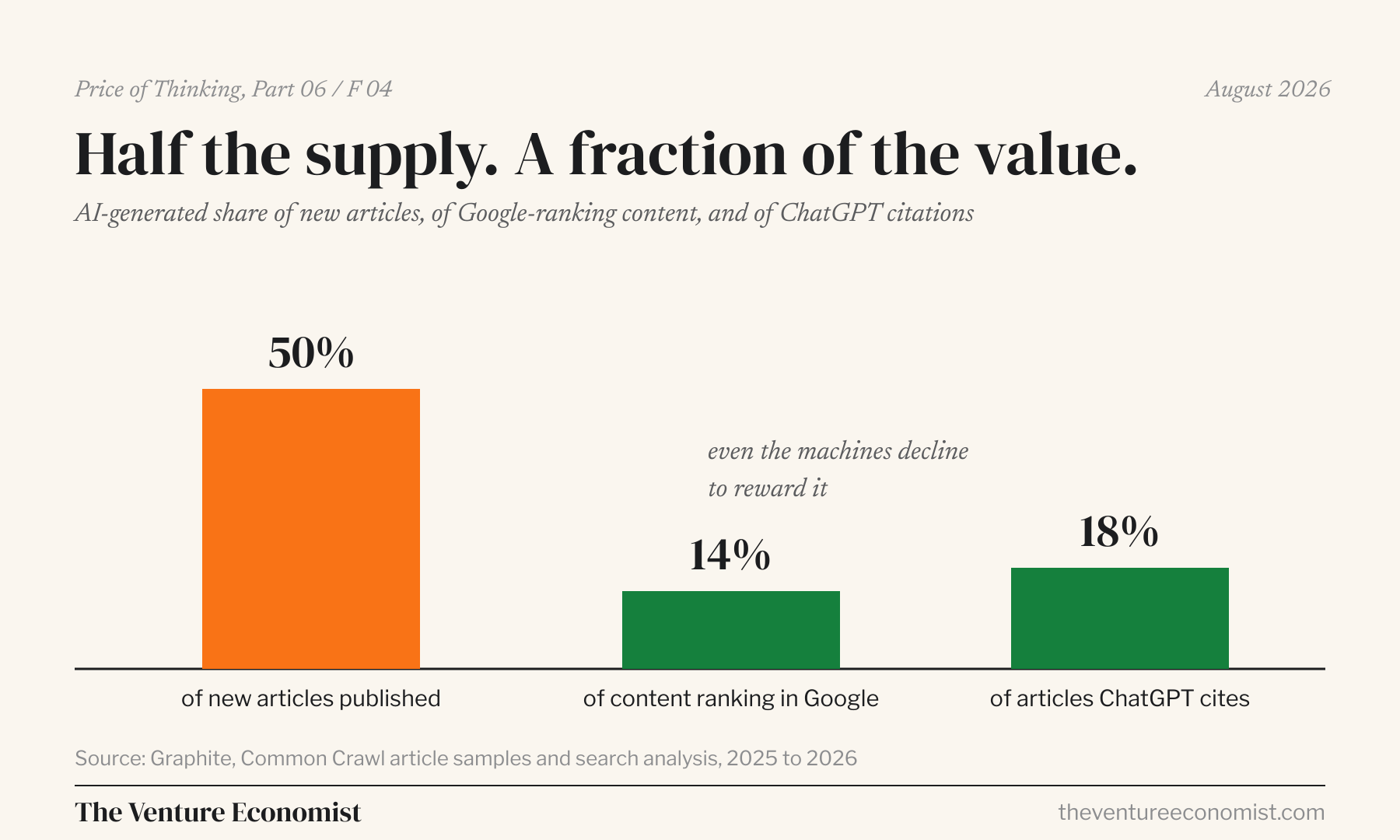
The market has already run this experiment at scale. Roughly half of all new articles published online are now AI-generated, according to Graphite’s analysis of tens of thousands of web pages. Yet in Graphite’s earlier work, only about 14 per cent of content that ranks in Google search is AI-generated, and ChatGPT itself cites human-written articles 82 per cent of the time. Half the supply, a fraction of the value. The machines are producing text that even the machines decline to reward.
Environmental value aside, if a tree grows in a forest it has no economic value until we cut it down and turn it into wood for, say, a house. It is the same with AI. If it generates reams of text, that text has no value until a human interacts with it in some meaningful way.
So as AI is used more, more content is made, and demand grows for the jobs that create value from it. Deciding what to write. Deciding why it should be written at all. Judging whether it is any good, against a human’s desired outcome.
That is what makes a role complementary to AI.
Is software engineering a dead-end career?
The evidence says the opposite: the volume of code is exploding, and the demand sits with the humans who turn code into outcomes.
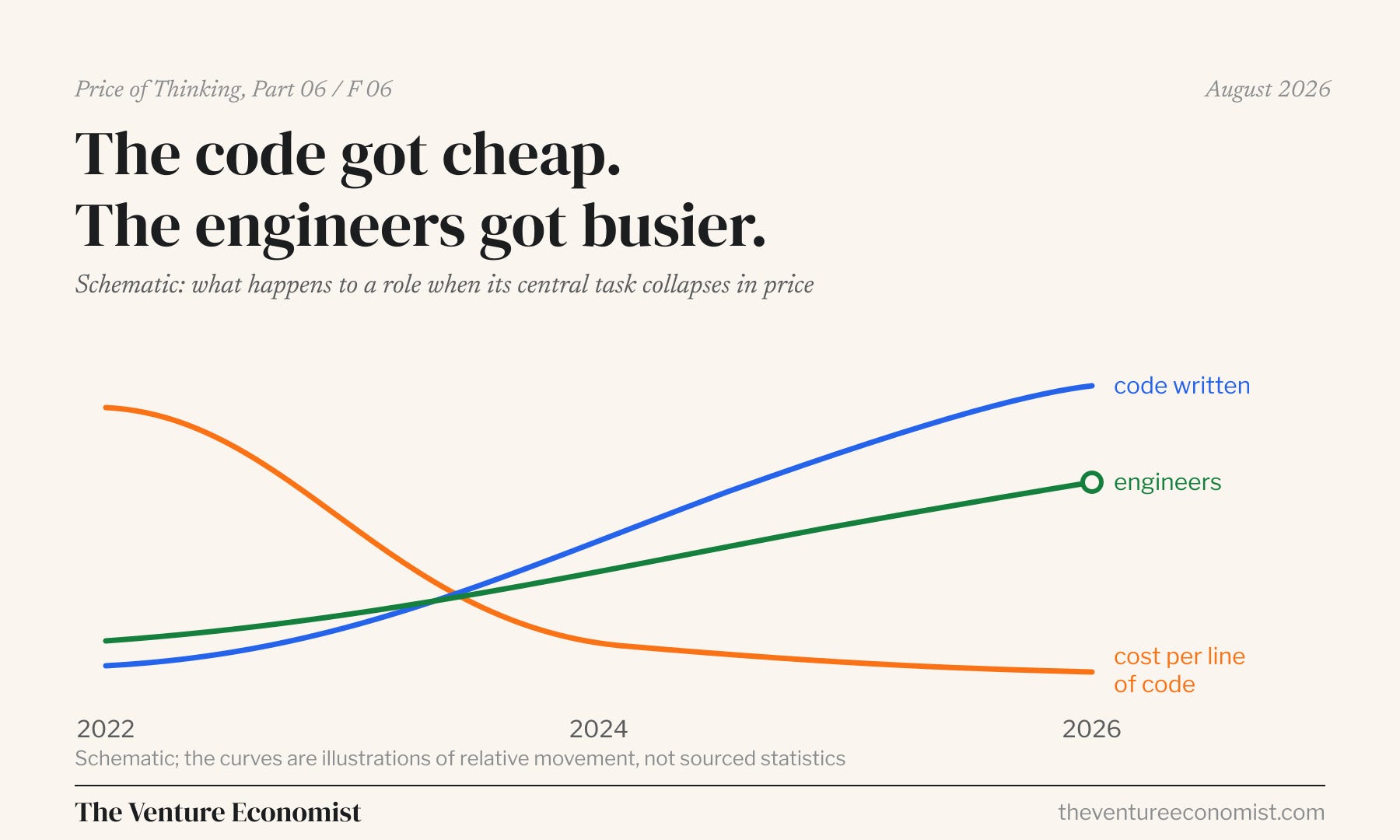
Because of AI, we are writing more code than ever. In October 2024, Sundar Pichai said AI was generating more than a quarter of all new code at Google. By April 2025, Satya Nadella put Microsoft’s figure at 20 to 30 per cent. By this year, Pichai’s number had reached 75 per cent of new code at Google, approved by engineers. The cost of a line of code is collapsing, and exactly as the Jevons post in this series predicted, the supply of code has risen dramatically in response.
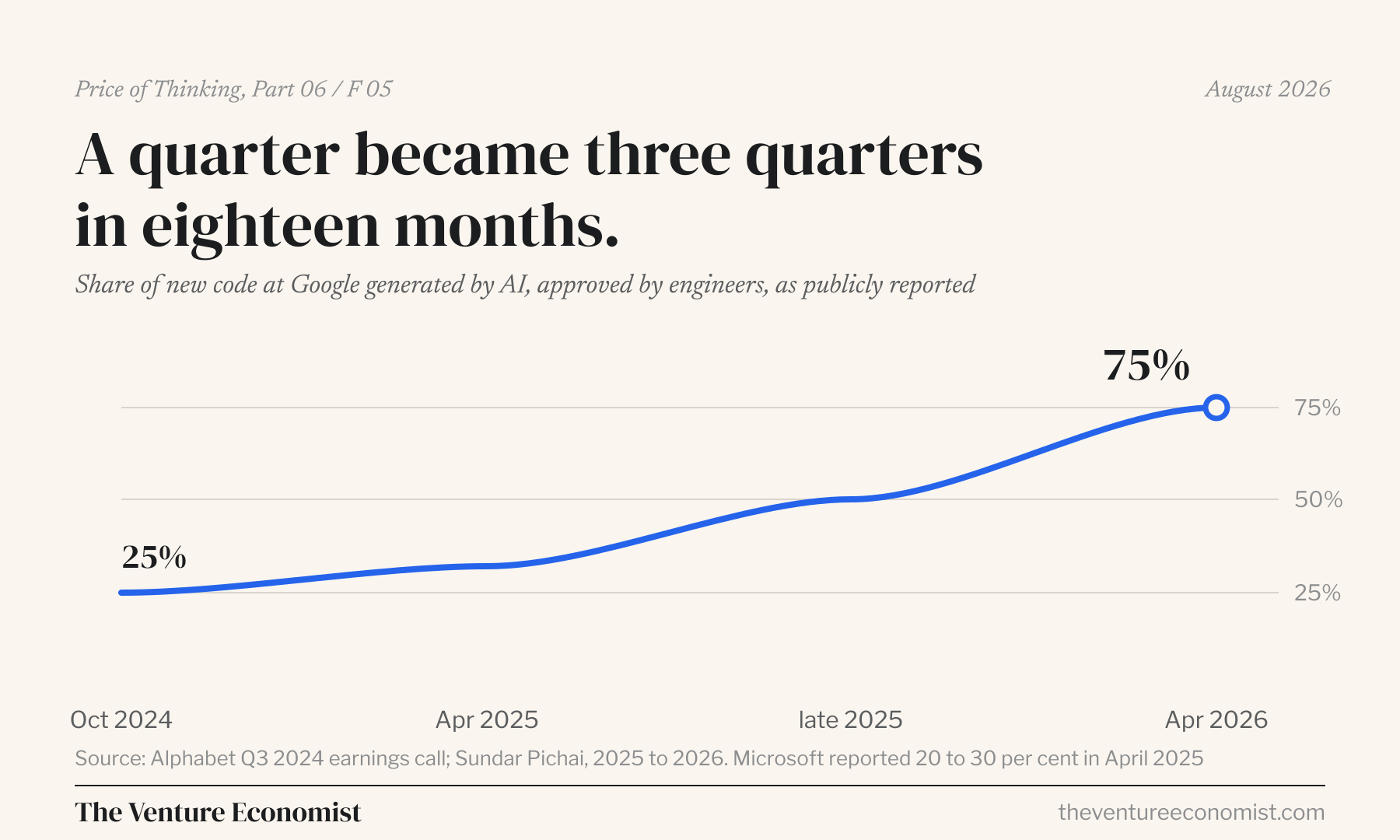
But software engineers are still required for that code to generate economic value. The tasks may evolve. The demand for the role increases with the flood it has to govern.
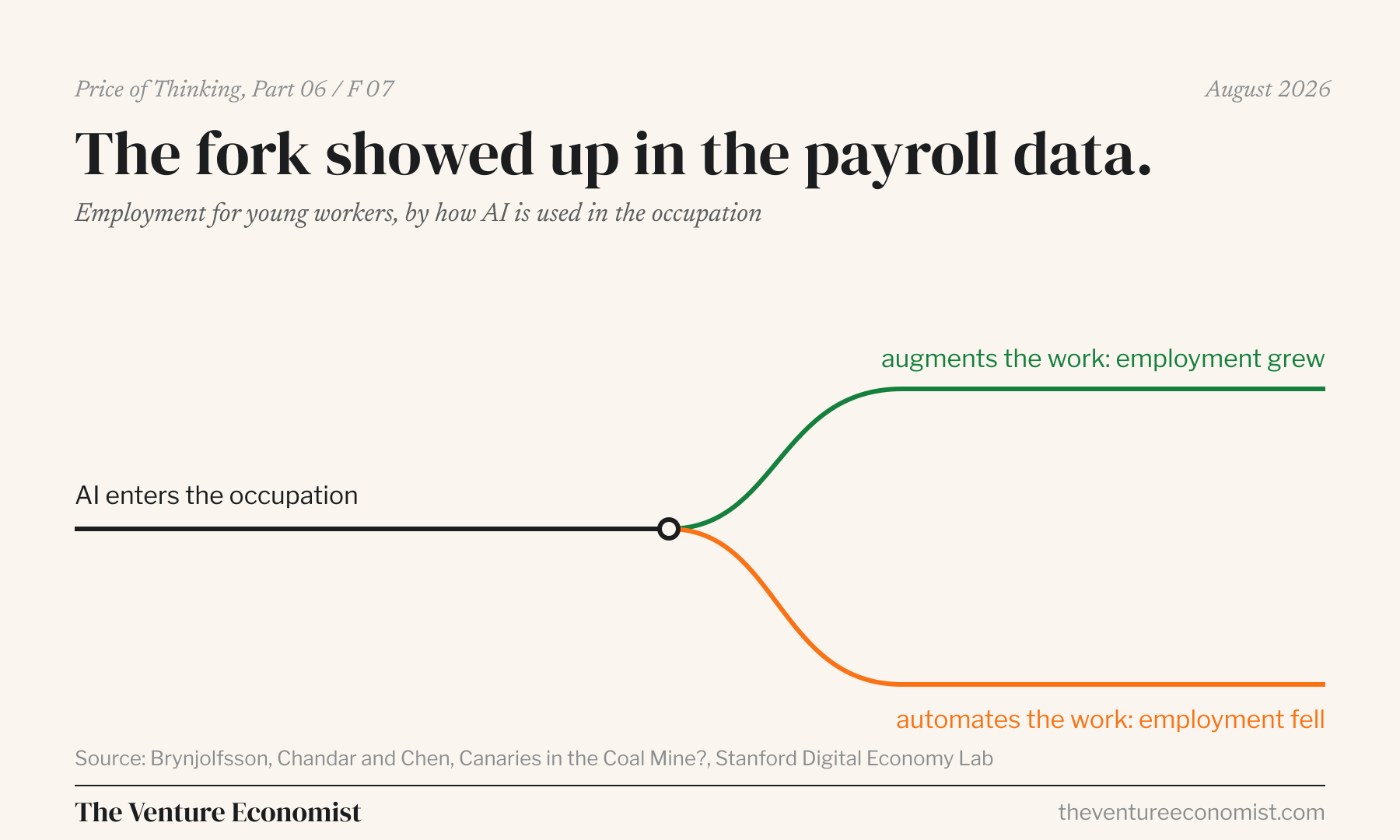
The Stanford data that fuelled the doom headlines actually contains the proof. Employment for young workers fell in occupations where AI automates the work, and grew in occupations where AI augments it. The line between the two is precisely the line between substitute and complement. And when Ramp and Revelio Labs linked real corporate AI spending to workforce records across 21,000 US firms, they found the heaviest adopters grew headcount 10.2 per cent in the two years after adoption, with entry-level roles up 12 per cent. The companies buying the most machine intelligence are hiring the most humans.
Humans are the economy
This is where I think the current discourse around AI is wrong. We have been painting a world in which humans are no longer required for an increasingly large share of economic output. The age of abundance, underwritten by Universal Basic Income. I think this is fundamentally incorrect.
Humans are the economy.
The increasing intelligence of AI models is reducing the price of intelligence. For that intelligence to hold any value in the economy requires humans, definitionally, to turn the intellectual output of the models into outcomes and relationships.
The two jobs AI was supposed to take first were the first to demonstrate it. Which raises the question this series turns to next: if the thinking is cheap and the value sits with the human, what exactly is the human being paid for?
Sources
Hui, X., Reshef, O., Zhou, L., “The Short-Term Effects of Generative Artificial Intelligence on Employment” (Upwork writing jobs and earnings): https://olin.washu.edu/about/news-and-media/news/2023/08/study-ai-tools-cause-a-decline-in-freelance-work-and-incomeat-least-in-the-short-run.php
Demirci, O., Hannane, J., Zhu, X., “Who is AI Replacing?” (freelance posting declines by category): https://the-decoder.com/generative-ai-reduces-demand-for-some-freelance-jobs-in-writing-coding-and-design-study-says/
Brynjolfsson, E., Chandar, B., Chen, R., “Canaries in the Coal Mine? Six Facts about the Recent Employment Effects of Artificial Intelligence”, Stanford Digital Economy Lab: https://digitaleconomy.stanford.edu/publications/canaries-in-the-coal-mine/
Ahrefs, “So You’ve Been Asked To Humanize AI Content” (search demand growth): https://ahrefs.com/blog/humanize-ai-content
NBC News via Yahoo, “Desperate Companies Now Hiring Humans to Fix What AI Botched”: https://www.yahoo.com/news/articles/desperate-companies-now-hiring-humans-204421933.html
Graphite, AI-generated article share of the web, via Search Engine Land: https://searchengineland.com/nearly-half-online-articles-ai-generated-study-478233
Graphite, AI content in search rankings and LLM citations, via Notebookcheck: https://www.notebookcheck.net/More-than-half-of-online-written-content-is-AI-generated-new-study-says.1139179.0.html
The Hill, “Google CEO says more than 25 percent of company’s new code written by AI”: https://thehill.com/policy/technology/4962336-google-ceo-says-more-than-25-percent-of-companys-new-code-written-by-ai/
TechCrunch, “Microsoft CEO says up to 30% of the company’s code was written by AI”: https://techcrunch.com/?p=3000949
OfficeChai, “75% Of Code At Google Is Now Generated By AI”: https://officechai.com/ai/75-of-code-at-google-is-now-generated-by-ai-ceo-sundar-pichai/
Ramp Economics Lab and Revelio Labs, “A New Look at AI’s Impact on Jobs”: https://ramp.com/data/heavy-ai-adopters-hire-more