

Keynes promised a fifteen-hour week. The Jevons Paradox explains why it never arrived, and why AI will not deliver it either.
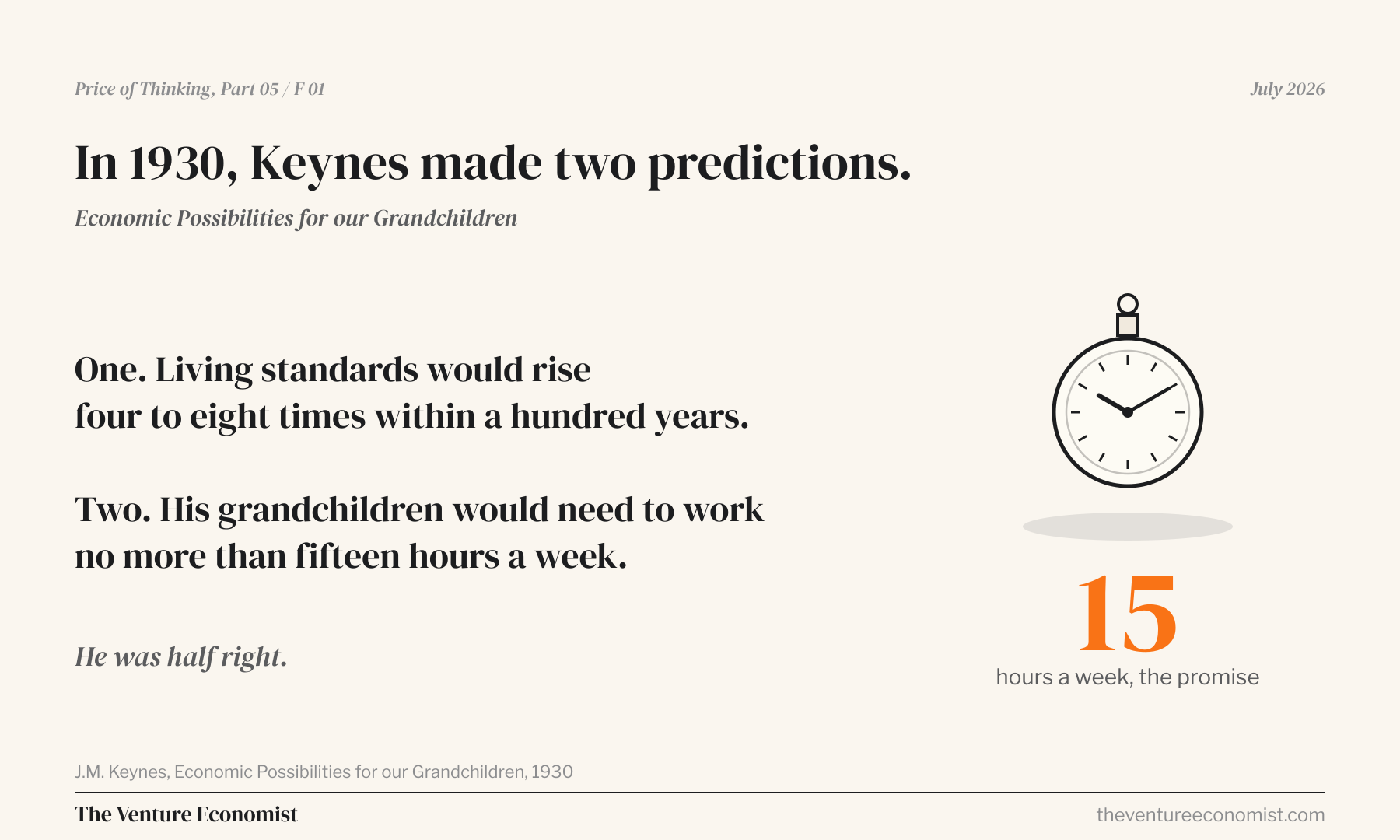
In 1930, John Maynard Keynes wrote an essay predicting that within a hundred years, living standards in the rich world would rise between four and eight times, and that the great problem facing his grandchildren would be what to do with all the spare time. “Three-hour shifts or a fifteen-hour week,” he suggested, might be needed just to keep people feeling useful.
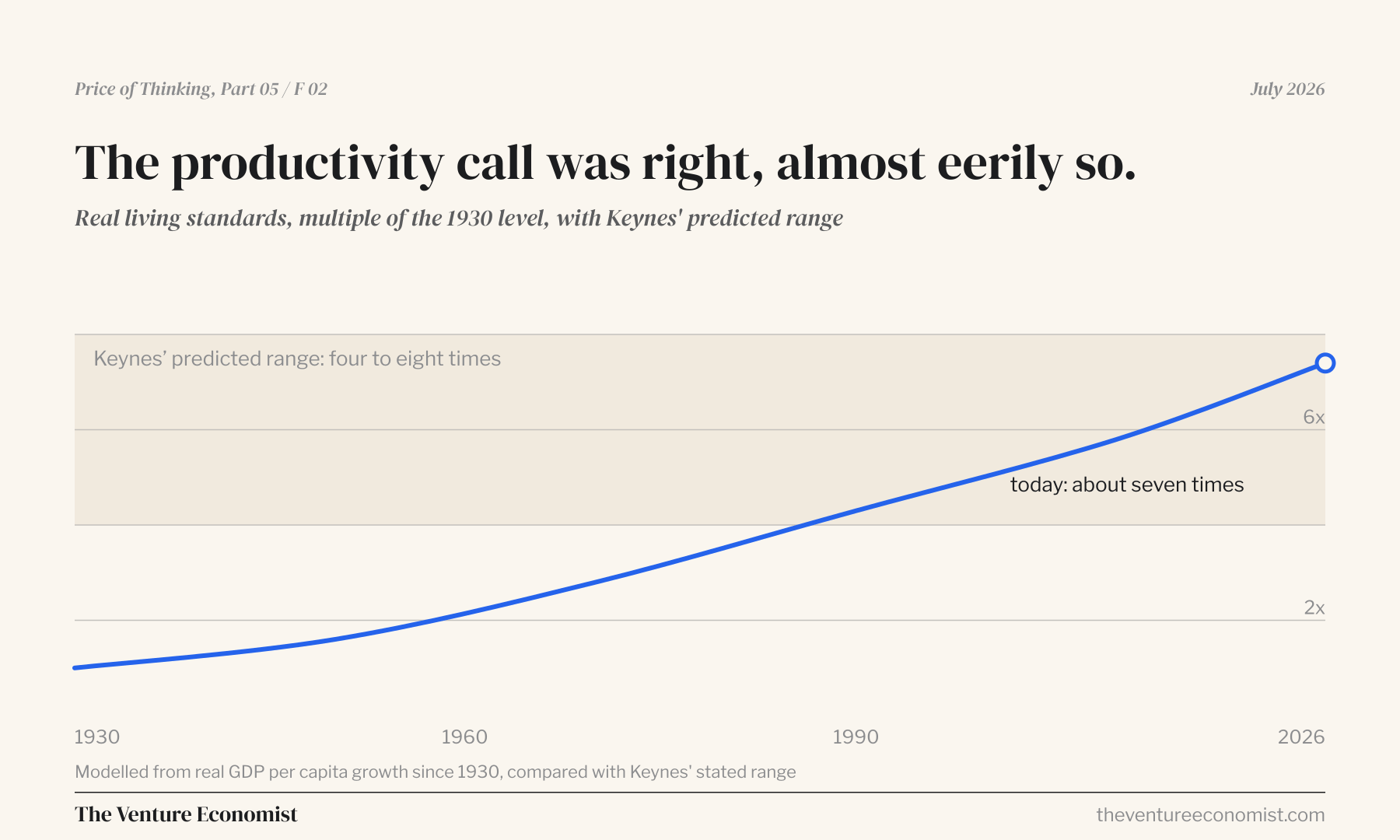
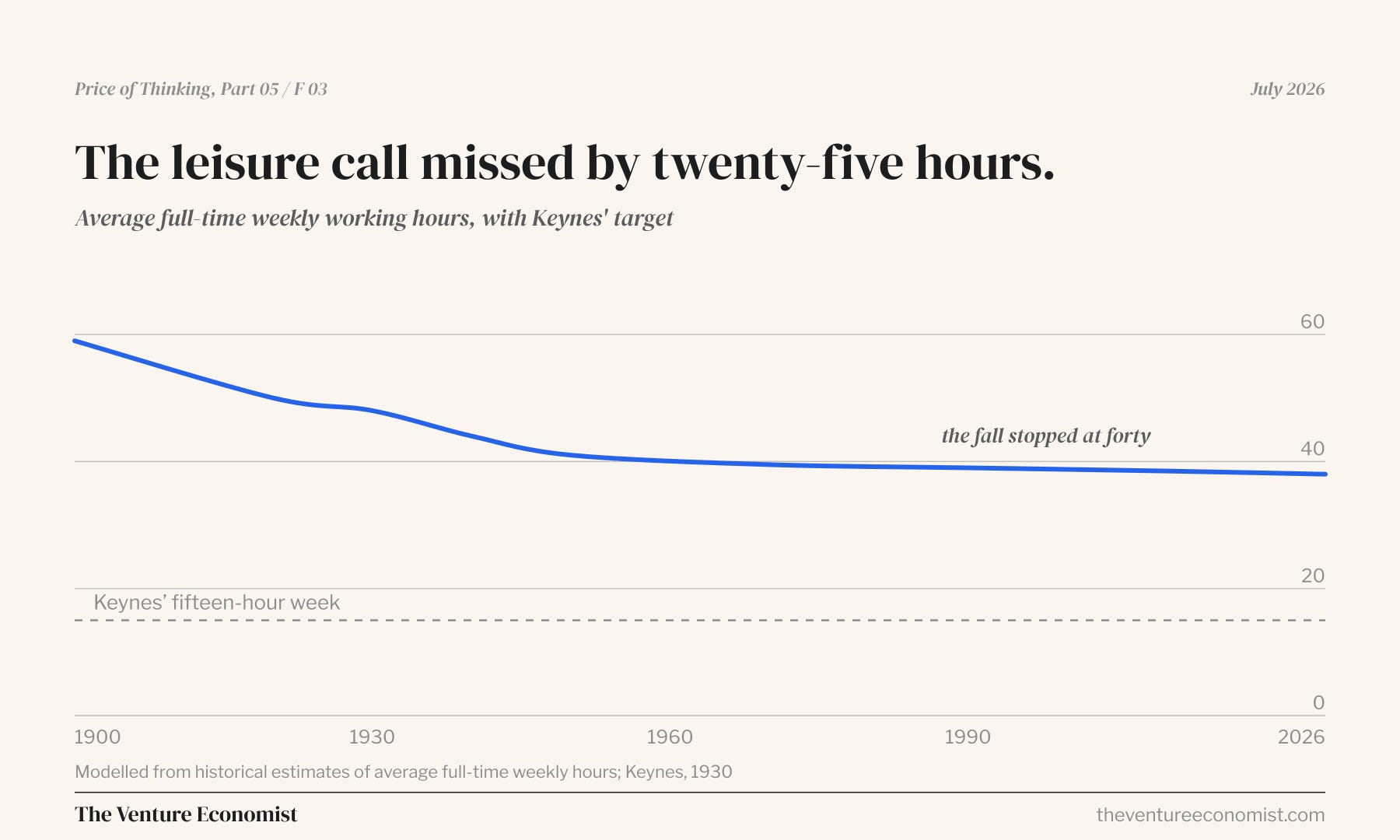
Keynes nailed the productivity prediction: living standards have risen sixfold to eightfold since 1930. But while working hours fell for a while, from around fifty a week toward forty, they stopped falling in around 1960 and haven’t fallen much further since. His grandchildren’s generation reports being busier than any before it.
Why did the fifteen-hour week never arrive?
Last article covered The Jevons Paradox: when technology makes a resource more efficient, total consumption of the resource rises, because the effective cost of an outcome falls provided there is latent demand for that outcome. We watched it happen to coal, and then to LLM tokens, where prices fell a thousandfold and consumption rose to the quadrillions.
Keynes assumed a productive economy would bank its efficiency as leisure - essentially keeping the amount of work done fixed and reducing the time to do it. This almost never happens.
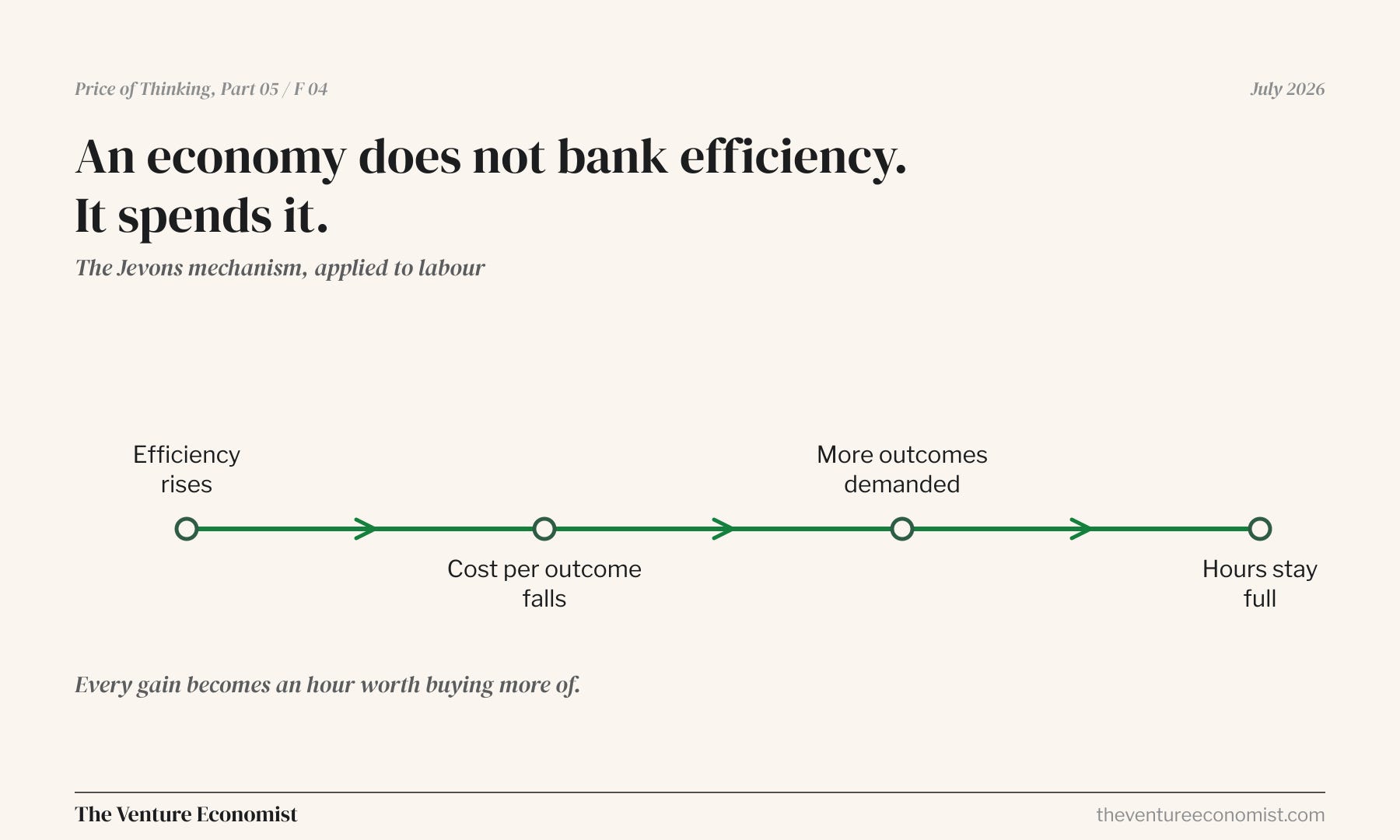
Jevons says an economy does not bank efficiency at all. It spends it on more output, more projects, more of everything that was previously too expensive to attempt. Every hour of labour that technology made more productive became an hour worth buying more of, and the demand for outcomes kept absorbing the gains that were supposed to become free time. That is not a moral failing or a management fashion. It is The Jevons Paradox operating on labour instead of fuel.
AI is the largest efficiency gain intellectual labour has ever received, which means the machinery that consumed Keynes’ fifteen-hour week is now pointed directly at knowledge work.
What does the Jevons Paradox say about knowledge work?
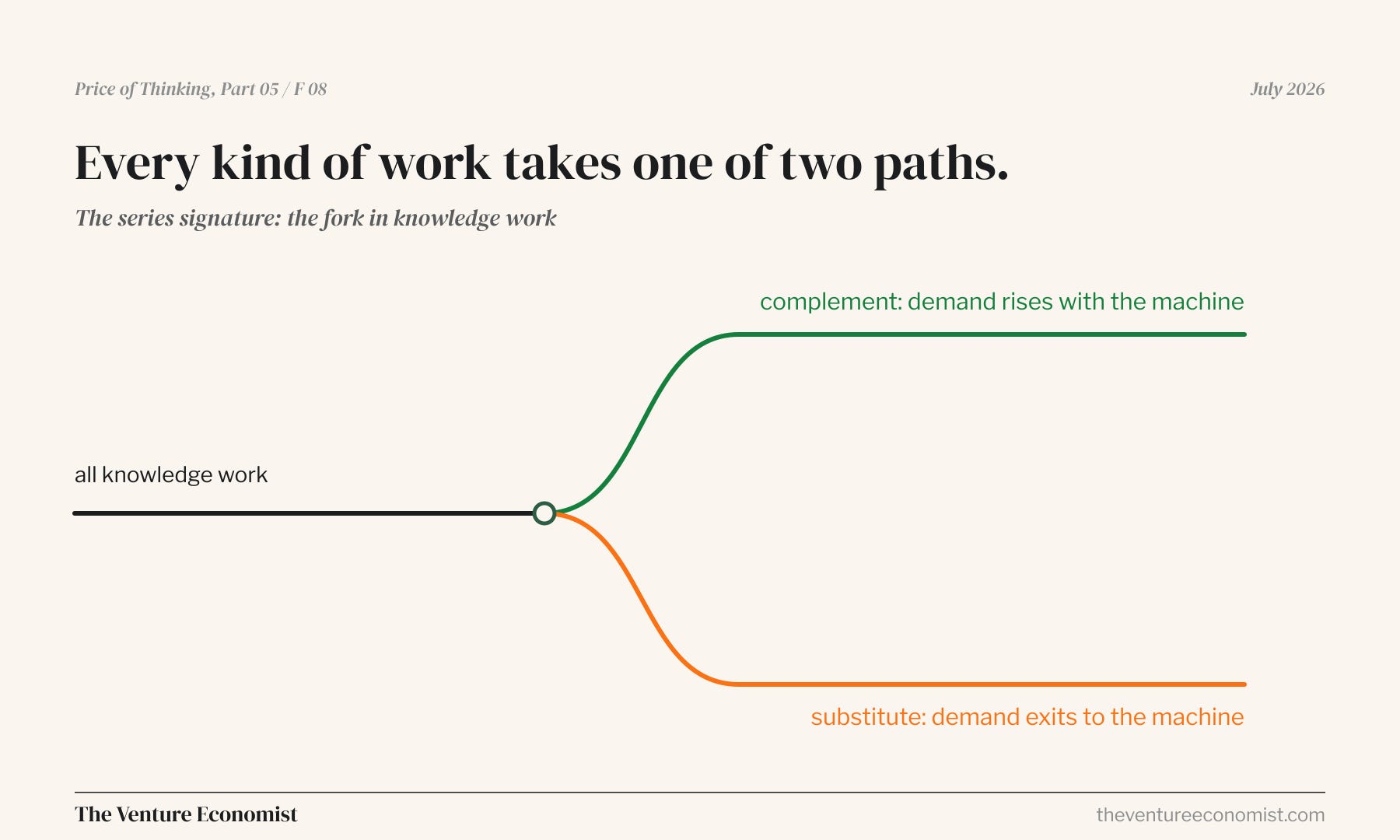
Knowledge work is a complement to AI: every token a firm generates still needs human judgement around it, someone to decide what to ask, assess the answer, and carry the consequences, so demand for tokens lifts demand for that judgement.
And AI simultaneously makes that judgement work more productive: an analysis that took a week takes a day, so the price per unit of knowledge work output falls, while the wage does not.
A resource just became dramatically more efficient, and its cost per outcome dropped. The economy responds to knowledge work exactly as it responded to coal and tokens and every productive hour since 1930. It orders more.
What work becomes affordable when the cost of thinking falls?
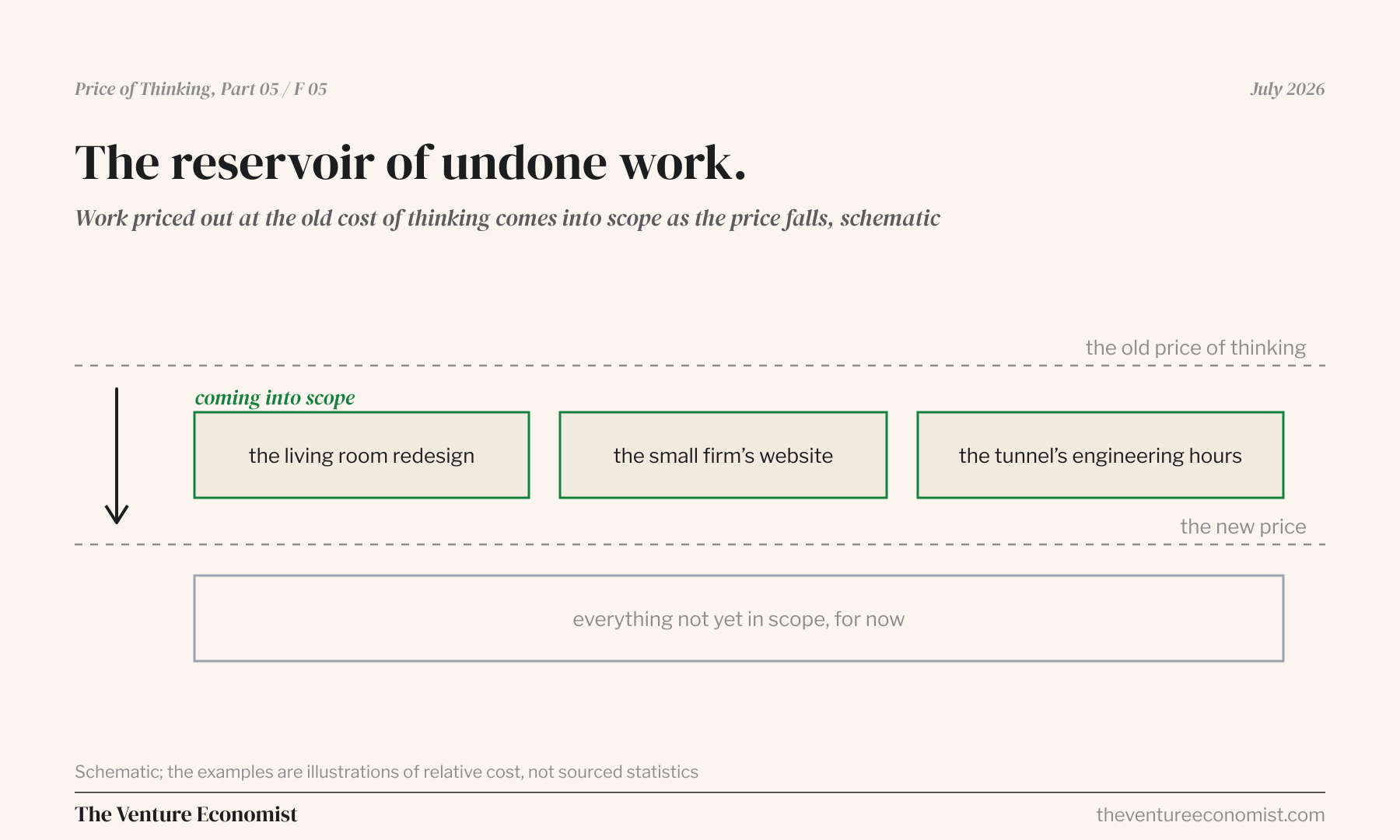
A great deal of the world’s work never happens for one reason: the thinking costs an order of magnitude too much. The living room that never gets redesigned at the architect’s old price. The business that never commissioned a website at ten thousand dollars and runs one now that it costs hundreds, which is why there are more websites, and more web work, than ever. One reason a tunnel or a road costs what it does is the sheer expense of the engineering hours wrapped around it, and none of the world’s appetite for infrastructure is close to satisfied. Each of these is a queue of outcomes waiting for the price of thinking to fall, and the price is now falling, dramatically.
Does AI adoption increase or decrease hiring? What the data shows
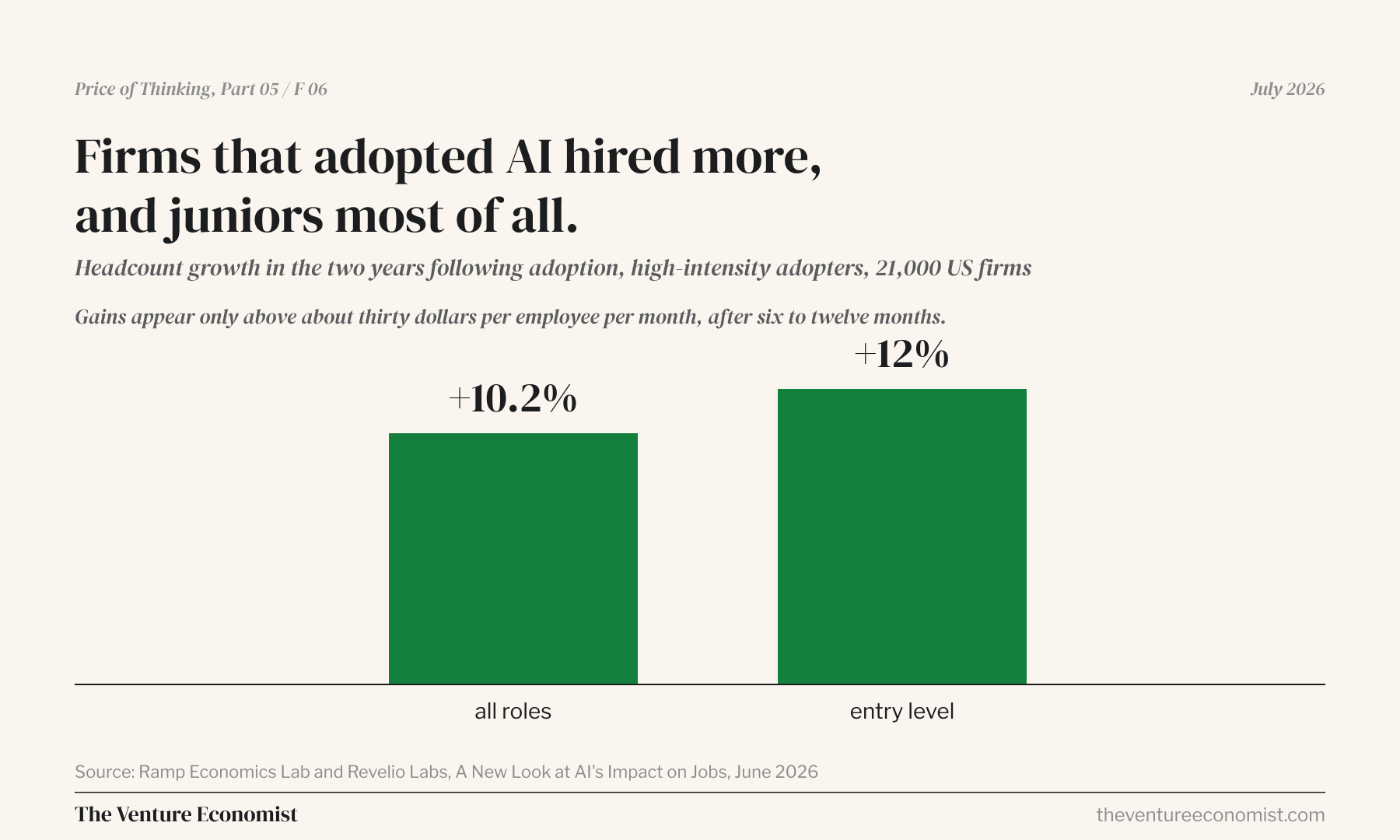
This June, the theory of AI related job increases got its first proper dataset. Economists at Ramp and Revelio Labs joined real corporate AI spending, taken from card transactions, to workforce records across more than 21,000 US companies, so they could watch what actually happens to headcount after firms adopt AI. Adopting firms grew headcount 10.2 percent over the two years following adoption. Entry-level headcount, the layer every headline says AI is erasing first, grew faster still, at 12 percent.
The conditions attached are as instructive as the finding. The gains appeared only in high-intensity adopters, roughly the top third of AI spend per employee, and that threshold is about thirty dollars per employee per month, hardly a moonshot budget. They arrived only after a learning curve of six to twelve months, the time it takes new ways of working to spread through teams. And small firms, when they adopted at all, adopted most intensely, because AI lowers the fixed cost of capabilities that once required whole salaried teams.
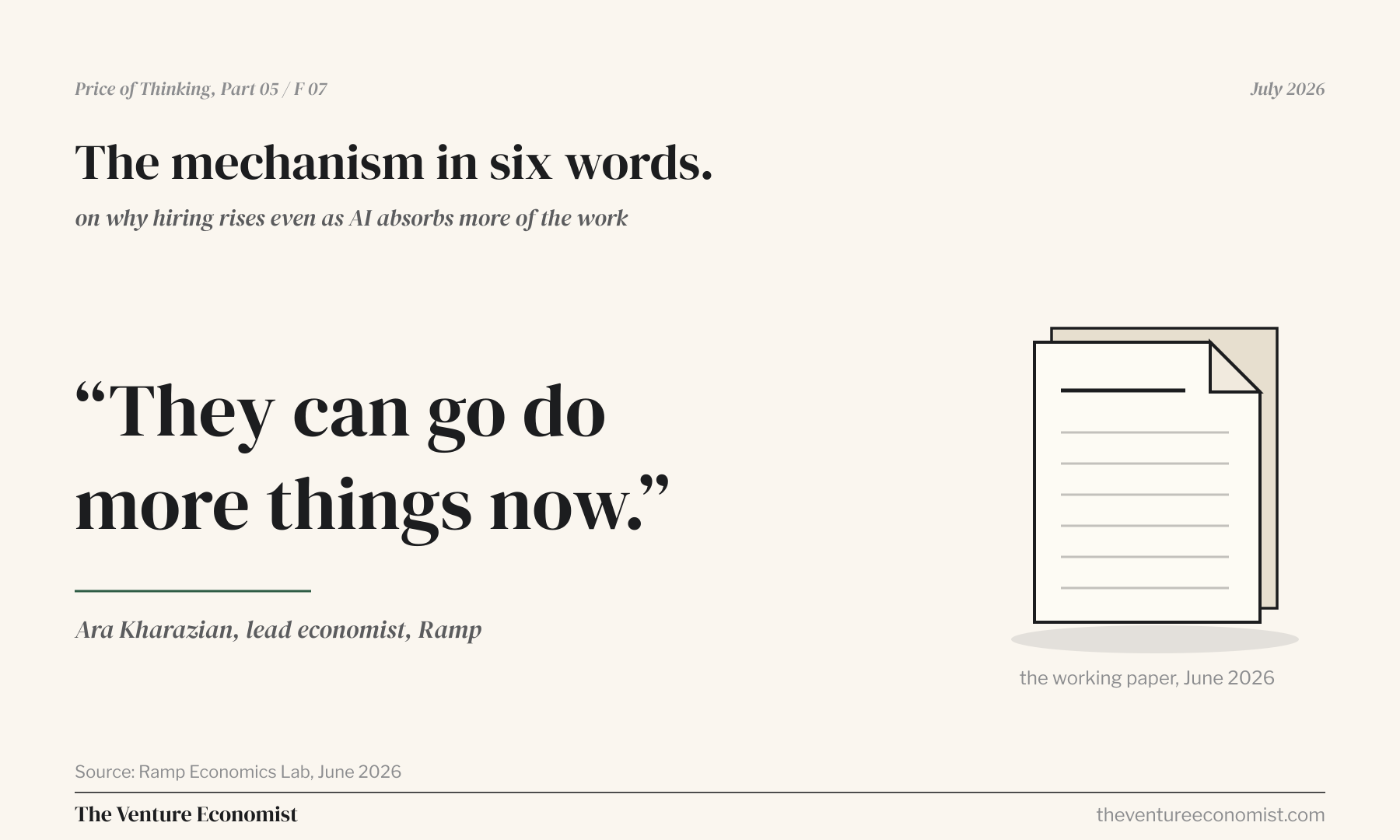
Ramp’s lead economist, Ara Kharazian, explaining why hiring rises even as AI absorbs more of the work, landed on the mechanism in six words: “They can go do more things now.” A hundred and sixty years after Jevons, that is the paradox restated.
Historical Side Note: Jevons might have enjoyed this chapter more than anyone. A few years after the coal book, he built a mechanical device he called the logical piano, which could work through logical deductions faster than he could manage by hand. The man who described the paradox also built one of the first machines that worked like a computer.
Will AI give workers more free time?
The honest answer is the one Keynes’ grandchildren could give. Productivity arrived beyond his estimates, and the economy spent every hour of it on outcomes rather than leisure, because that is what economies do with efficiency. There is no reason to expect the largest productivity gain in the history of intellectual labour to be the first one banked as free time. If AI has left you busier than ever, you are not doing it wrong. You are a complement to the machine, in an economy that has just discovered your outcomes cost a fifth of what they did, and it is ordering accordingly.
The fifteen-hour week is sadly not coming, not if history is any guide. Universal Basic Income (UBI)? Not according to economics. Something better might be: the same hours, spent on problems that were never affordable before. What that looks like inside an actual profession is where this series goes next, because the two occupations AI was supposed to empty first have now run the experiment for three years, and both of them are hiring.
Sources
Keynes, J.M., “Economic Possibilities for our Grandchildren” (1930), public domain.
Ramp Economics Lab (Kharazian, A.), “Companies hire more after AI adoption,” June 2026: https://ramp.com/data/heavy-ai-adopters-hire-more
Ramp and Revelio Labs working paper, “A New Look at AI’s Impact on Jobs”: https://ramp.com/data/ai-jobs-impact
Living standards multiple is real GDP per capita growth since 1930, a modelled comparison against Keynes’ stated range, not a single published statistic. The architect and website examples are illustrations of relative cost, not sourced market statistics.